CVWiser blog
How to Explain a Career Gap on Your Resume (and in Interviews)
Put an employment gap on your CV honestly, keep the explanation short, and pivot to proof. What to say in interviews, what to skip, and how not to invent fillers.
A career gap is common. Layoffs, caregiving, health, relocation, study, or a long search all leave empty months on a timeline. What sinks applications is not the gap itself. It is inventing filler jobs, vague date math, or a five-minute apology in the interview.
This guide covers what to show on the CV, what to say when a human asks, and what never to fake. It pairs with your master profile, interview defense, and fact-check habits.
The short answer
- Keep real dates on every role. Do not stretch end dates to hide empty months.
- On the CV, be brief. A one-line note is enough for longer breaks; skip a novel in the experience section.
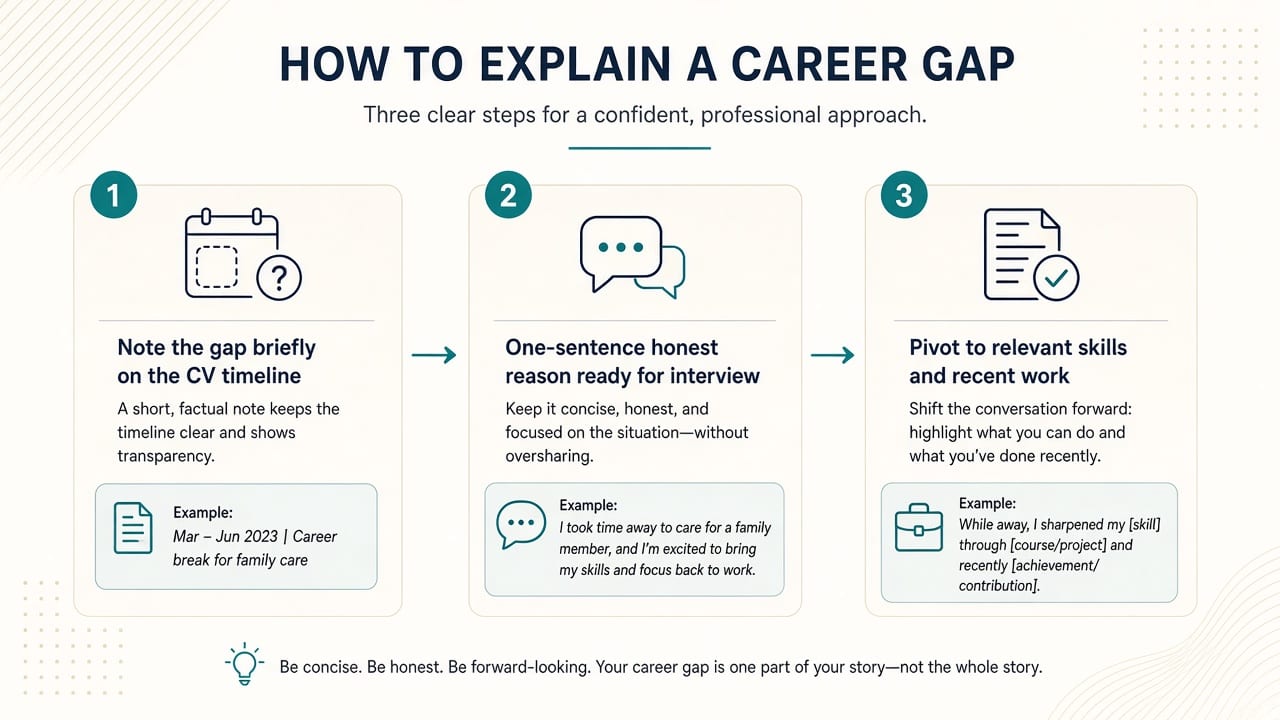
- In the interview, use three beats: honest reason → what you kept current → why you are ready for this role.
- Never invent employers, titles, freelancing, or education to "fill" the gap.
- Practice the answer out loud so you do not overshare or spiral (interview defense).
Does a career gap kill your application?
Usually no, if the rest of the package is clear and true. Recruiters see gaps constantly. They care more about:
- Whether dates look manipulated
- Whether your recent skills still match the posting
- Whether you can explain the break calmly in one minute
A match score that ignores eligibility and honesty still fails. Gaps are a human conversation, not an ATS trick.
How to show a gap on the resume
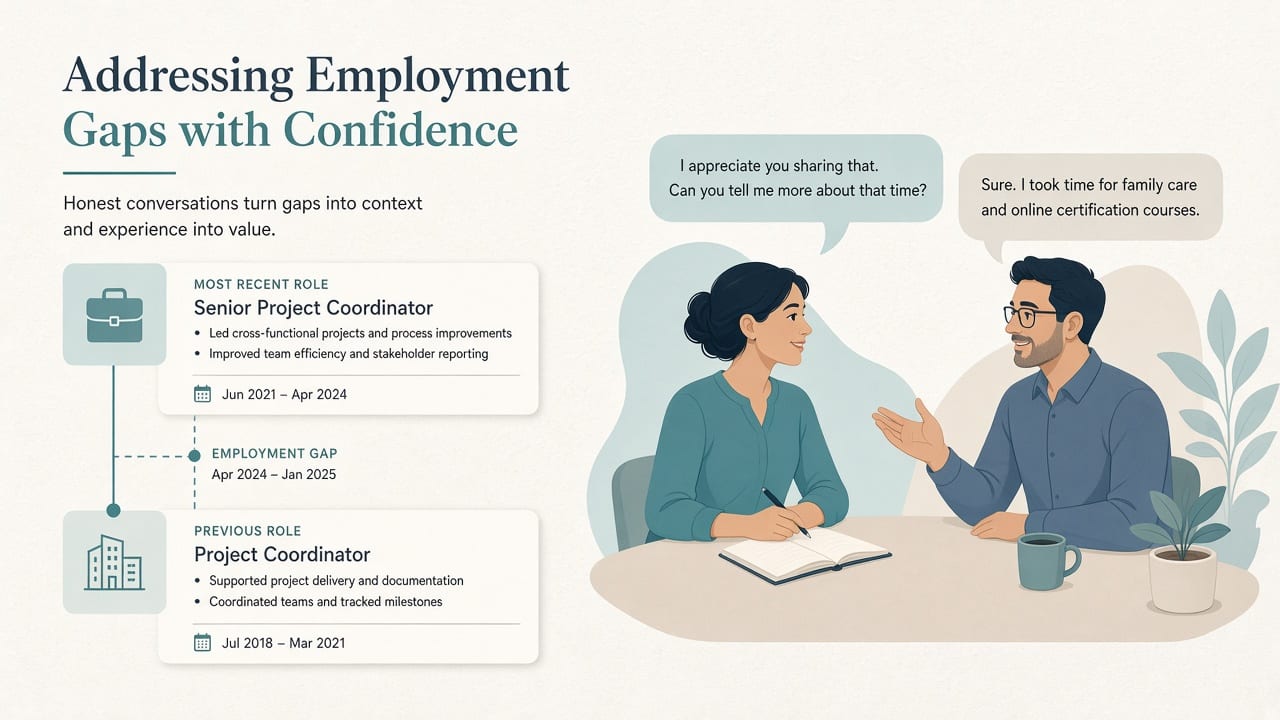
Keep the chronology honest. Month/year (or year) for each role. If you left in March and started again in November, leave that space. Do not backdate.
Optional one-liner for longer breaks (6+ months):
Under experience or in a short "Career note," something like: "2023–2024: full-time caregiving" or "2024: career break after layoff; completed XYZ coursework." Only include what you are willing to discuss.
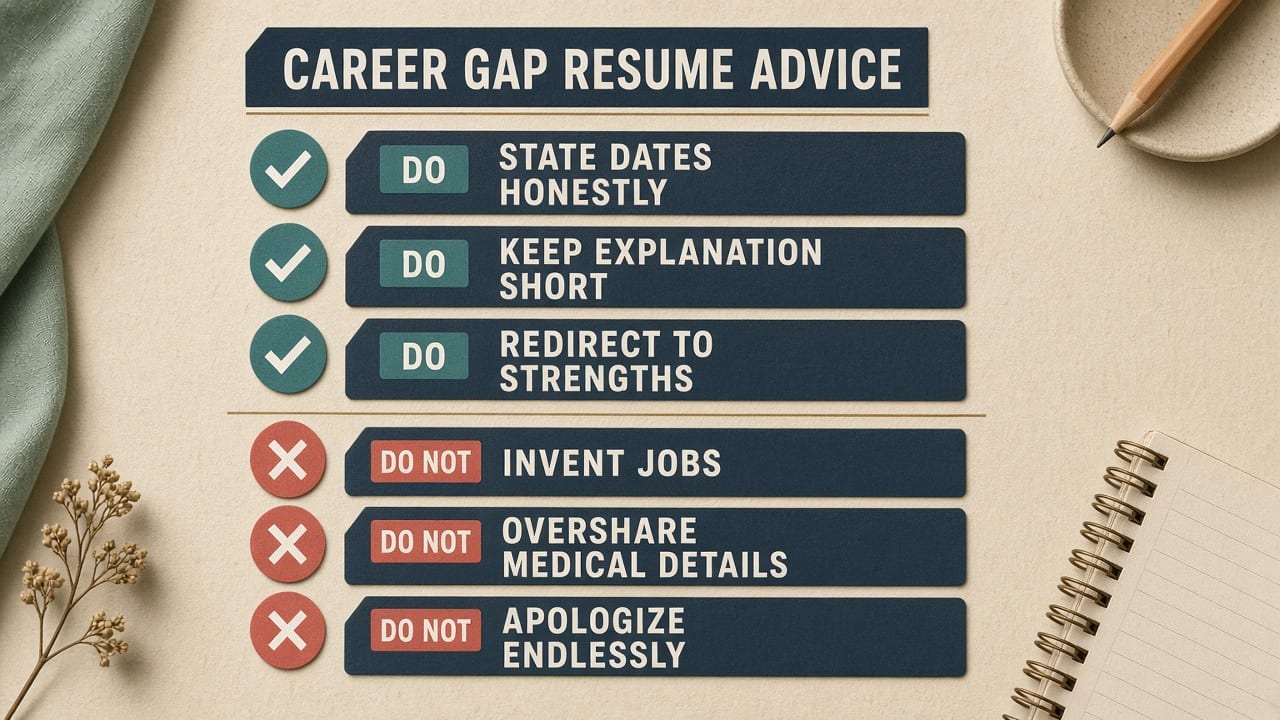
Do not:
- List fake consulting / "self-employed" with no real clients
- Pad with unpaid titles that imply employment you did not have
- Hide overlapping or missing months with fuzzy "2022–Present" stacks
- Write a paragraph of personal detail on the CV
Save depth for the interview. Keep the document parseable and focused on proof for this job (tailor without lying).
Interview script: three beats, under 60 seconds
1. Name it once
"I was out of the workforce from June to December after a layoff / for caregiving / while relocating."
2. Bridge with something real
"During that time I finished a certification in X / did volunteer bookkeeping for Y / stayed current by shipping personal projects in Z." Only say what is true.
3. Pivot to this role
"I am ready for full-time work again, and this role matches the ops / product / engineering work I did at [last real employer]."
Then stop. Do not apologize three times. Do not dump medical or family detail the interviewer did not ask for. If they ask a follow-up, answer briefly and return to skills.
Example lines (adapt, do not copy blindly)
- Layoff: "My team was reduced in May. I used the next few months to interview and refresh my SQL skills. I am looking for a stable analyst role like this one."
- Caregiving: "I stepped away to handle family care. That chapter is closed. I am returning with the same project management experience I had at [employer]."
- Health (keep high-level): "I took medical leave and I am cleared to work full time. Happy to focus on how my last role maps to your stack."
- Study / relocation: "I completed [program] / moved cities, then restarted my search. Here is the most relevant work from before the break."
What not to do
- Invent jobs, promotions, or freelance gigs to close the timeline
- Blame a former employer for five minutes
- Overshare diagnoses, custody details, or trauma
- Claim "continuous employment" when dates show otherwise
- Let AI invent a consulting stint; reject it in Trust Diff
If AI suggests filler roles or stretched dates, delete them. Package generate cannot add employers, titles, dates, education, or new skill names. Chat can add facts you explicitly provide when you ask, so treat chat as less locked than generate.
Cover letter and LinkedIn
If you mention the gap in a letter, one sentence is enough, then skills for this posting. Keep CV and letter aligned (consistency check).
On LinkedIn, the same rule: real dates, optional short career-break note, no fake titles. Recruiters compare profiles to resumes.
Where CVWiser fits
CVWiser builds application packages from your master profile. It can rewrite your summary and refine bullets on existing roles, and reorder skills you already saved. It cannot add employers, titles, dates, education, or new skill names to fill a gap. Prompts tell the model not to invent exact numbers; still review Trust Diff and fact-check before export.
Capture a posting with the Chrome extension, see match before a generation credit, then export a parseable PDF/DOCX. Free plan: 3 application packages a month, no card. Start a fresh package or install the extension. Broader thesis: what CVWiser is really fighting.
Frequently Asked Questions
How do you explain a career gap in an interview?
State the reason in one sentence, mention anything relevant you did to stay current, then pivot to why you fit this role. Keep it under a minute.
Should I put a career gap on my resume?
Show honest employment dates. For longer breaks, a one-line career note is optional. Do not invent roles to hide the gap.
How long of a gap is too long?
There is no universal cutoff. Longer gaps need a clearer bridge to current skills. Honesty plus recent proof beats date gymnastics.
Can I say I was freelancing if I was not?
No. Fake freelance is still fiction and fails interview defense.
Will ATS reject me for a gap?
Most systems parse dates and text; they do not "reject gaps" like a magic rule. Humans decide after they see your package.
The short version
Leave the gap visible. Explain it once, briefly, without inventing fillers. Bridge to skills you can defend, then prove fit for this job. Fact-check dates before you send.