CVWiser blog
Career-Change Resume Without Lying: Transfer Skills, Keep Real Titles
Write a career-change resume that leads with transferable proof. Keep real titles and dates. Rewrite the summary, reorder skills, and never invent a job in the new field.
Switching fields is common. Inventing a title in the new field is not a strategy. Recruiters and hiring managers ask how you did the work. If the answer is "I rewrote my CV," the interview is already over.
A career-change resume still has to be true. You reorder proof, rename skills in the employer's language where you actually used them, and lead with overlap. You do not mint a fake Product Manager role because you sat in sprint meetings.
This sits next to tailor without lying, career gap, and your master profile. For networking without a posting, use a baseline CV. For a real JD, tailor a package.
The short answer
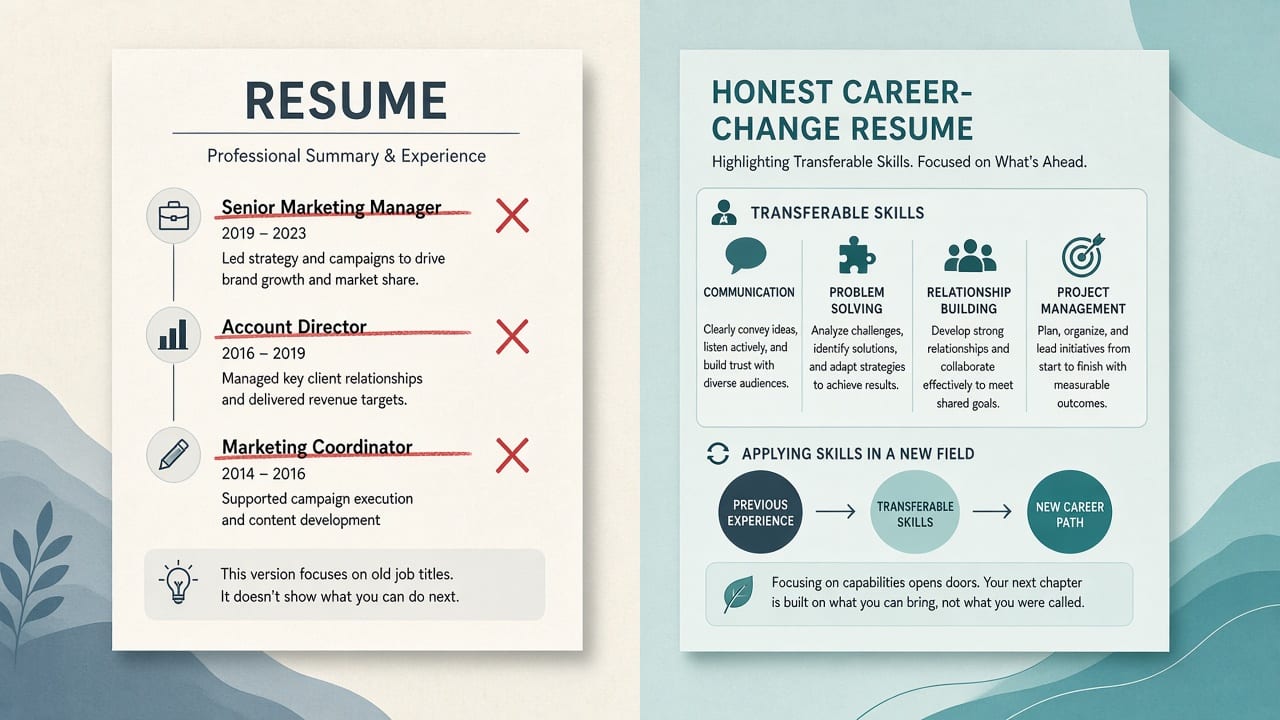
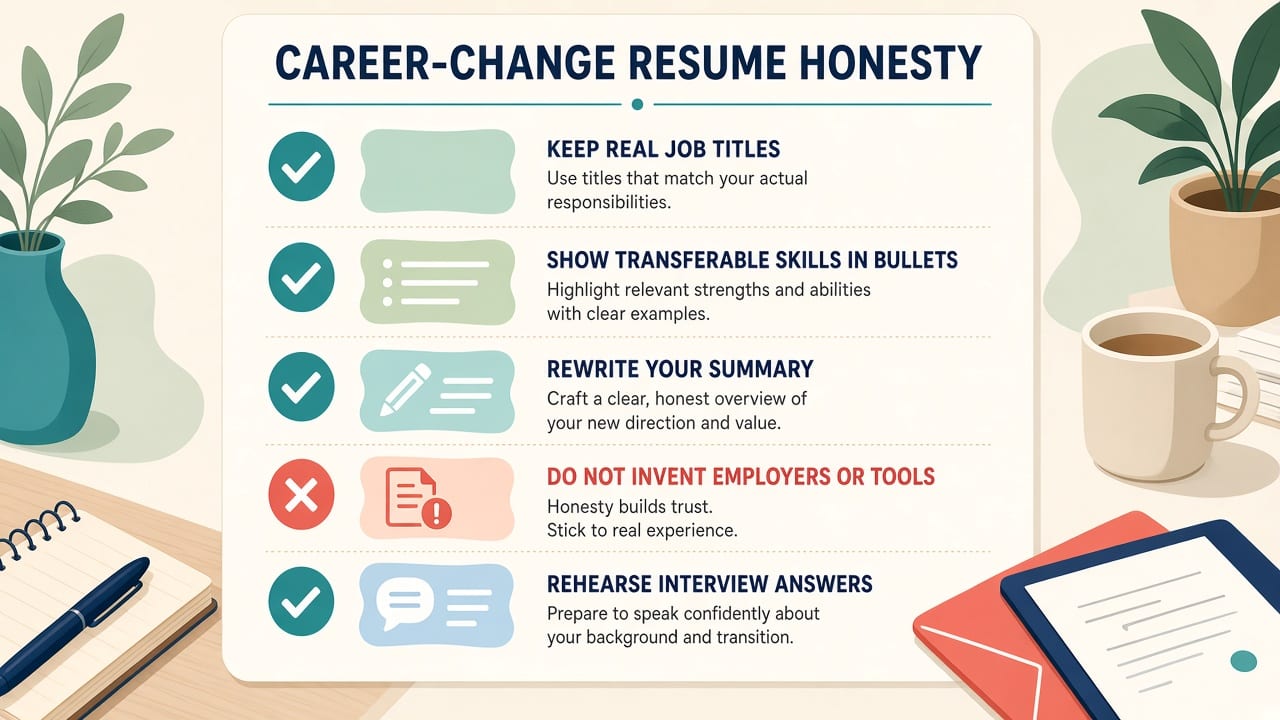
- Keep real employers, titles, and dates. Reframe bullets. Do not relabel the job.
- Lead with transferable proof in the summary and the first bullets of recent roles (summary without fluff, interview-ready bullets).
- Order skills for the target field only if you can defend them for a minute.
- Scan the posting first (2-minute scan). If must-haves are licenses or years in that exact title, eligibility may fail before match (eligibility check).
- Fact-check before send. Reject AI that invents tools or seniority (fact-check, Trust Diff).
What a career change is (and is not)
A career change is a new target role or industry, not a new invented history. Teacher to instructional designer, ops to customer success, analyst to product, nurse to health ops: the old titles stay. The story is transfer.
It is not:
- Changing "Coordinator" to "Manager" because the posting says Manager
- Adding Python, Figma, or Salesforce you never used
- Hiding years in the old field so you look like a junior in the new one (dates still have to parse)
Gaps during a transition stay visible and brief (how to explain a career gap).
Four moves that actually work
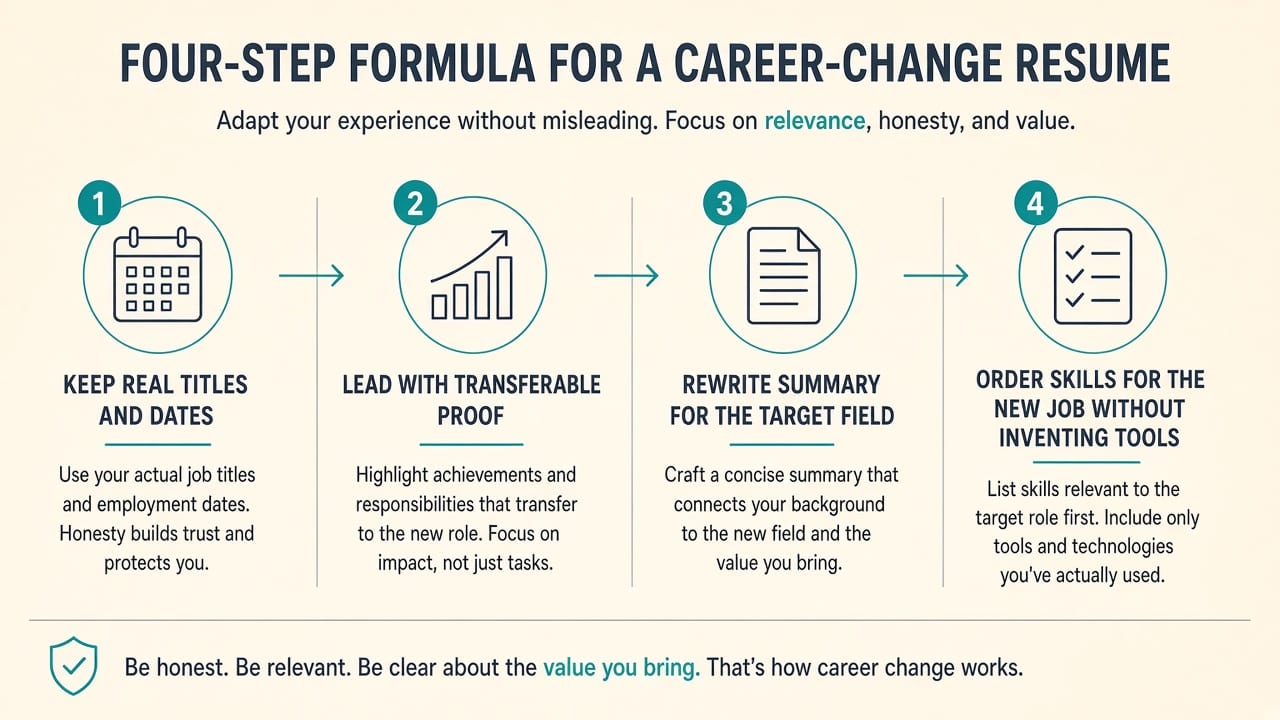
1. Identity in the summary, not a fake title in Experience
"Operations lead moving into customer success. Eight years owning onboarding, SLA recovery, and QBR prep for B2B accounts." That is framing. Listing "Customer Success Manager, 2018–2024" when you were Ops is fiction.
2. Bullets that name the overlap
Keep the real role. Put the transferable work first: stakeholder comms, metrics, tools adjacent to the posting, scope you can explain. Drop old-field jargon that hides the overlap.
3. Skills as an honest index
Reorder toward the target job. Do not paste the JD's stack (keyword stuffing).
4. Optional coursework or projects, labeled as such
A bootcamp, volunteer build, or personal project can live under Projects or Education. It is not employment.
Before / after (honest only)
Before (title inflation):
Customer Success Manager, Acme (2019–2024)
Owned the CS org and reduced churn 40% with AI.
After (real title + transfer):
Operations Specialist, Acme (2019–2024)
Ran onboarding for 60 B2B accounts; built a weekly health check used by account owners. Partnered with CS on churn reviews. Target: CS or onboarding-heavy AM roles.
Before (keyword dump):
Skills: Product, Jira, SQL, Figma, roadmap, discovery, Kubernetes...
After:
Skills you used: Excel, Salesforce reports, stakeholder workshops, SLA tracking. Put Figma or SQL on the page only if you did the work.
If you cannot walk through the line in 60 seconds, cut it (interview defense).
What to cut every time
- Fake titles in the new field
- "Career changer passionate about..." with no proof
- Tools from a weekend tutorial listed as production skills
- Cover letters that claim you "led product" when the CV says something else (consistency check)
- Hiding the old industry so hard that dates and LinkedIn contradict the PDF
Networking vs applying
No posting yet: send a baseline CV from the master profile (no AI, no generation credit). Update the profile so the baseline already leads with transferable bullets.
Have a posting: scan it, then tailor. Quality still beats spray-and-pray (quality vs quantity).
Where CVWiser fits
CVWiser generates application packages from your master profile. At generate time it can rewrite your summary and refine bullets on existing roles, and reorder skills you already saved. It cannot add employers, titles, dates, education, or new skill names. That lock is the point for career changers: the model cannot mint a title in the new field. Prompts tell the model not to invent exact numbers; still review Trust Diff and fact-check before export. Chat can add facts you explicitly provide when you ask, so treat chat as less locked than generate.
Capture a posting with the Chrome extension, see match before a generation credit, then export a parseable PDF/DOCX. Free plan: 3 application packages a month, no card. Start a fresh package or download a baseline from Profile. Broader thesis: what CVWiser is really fighting.
Frequently Asked Questions
How do you write a career-change resume?
Keep real titles and dates. Rewrite the summary for the target field. Lead each recent role with transferable proof. Reorder skills you actually have.
Should I change my job title to match the new field?
No. Use the title you would say in an interview. Mirror the posting's language in summary and bullets where it is true.
How do I show transferable skills?
Name them in Skills only if you can discuss them, and prove them in bullets with scope and result.
Can AI rewrite my career-change resume?
Yes as a draft locked to your profile. Reject invented titles, employers, and tools.
Do I need a functional resume to change careers?
Usually no. Chronological with honest titles plus reordered proof parses better and is easier to defend. Format still has to pass a copy-paste test.
The short version
Change the emphasis, not the employment history. Transfer real skills, keep real titles, tailor when you have a posting. If you cannot defend it in the new field, do not put it on the page.