CVWiser blog
Resume Bullets That Survive Interviews: Write Lines You Can Defend
Write resume bullets with action, scope, result, and proof you can explain in 60 seconds. Before/after examples, fluff cuts, and a fact-check before you apply.
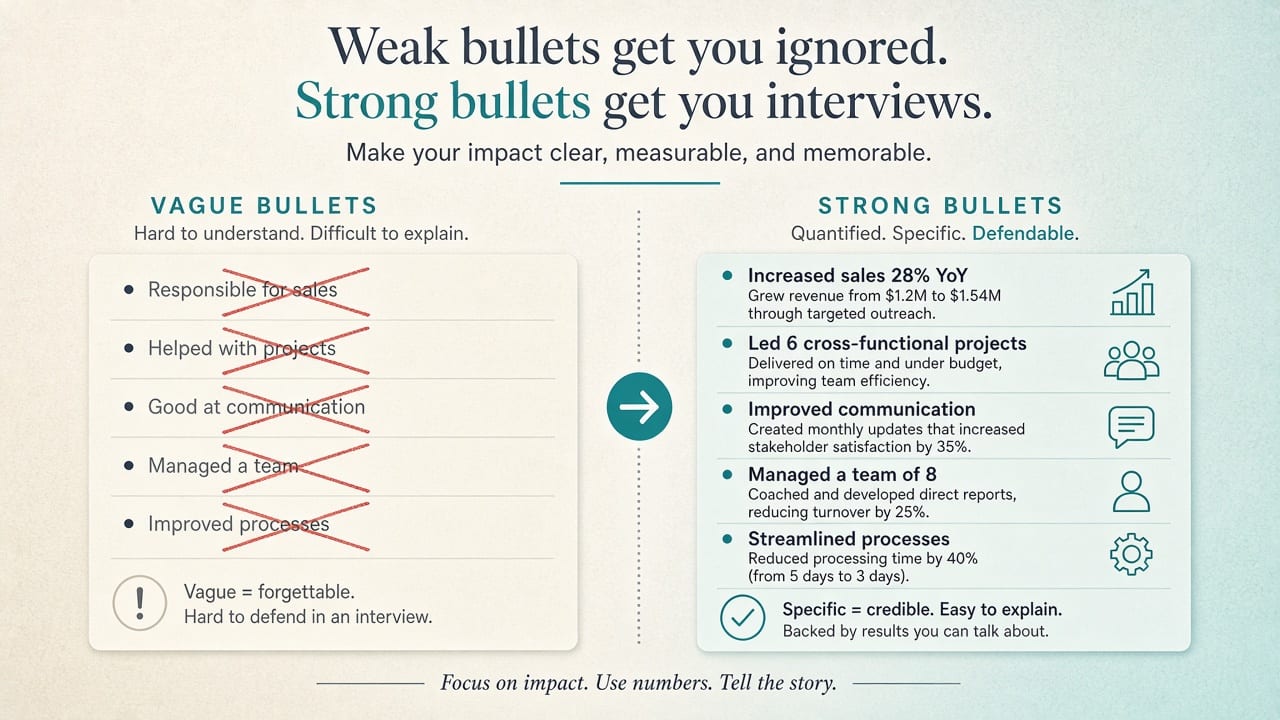
Pretty bullets get you the call. Defensible bullets get you through it. The lines that fail interviews usually look fine on paper: inflated metrics, tools you never used day to day, or vague "led initiatives" with no scope.
This guide is how to write experience bullets that still work when someone asks "walk me through that." It sits next to interview defense, fact-check, and tailor without lying. Your summary opens the story; bullets prove it.
The short answer
- Write from your master profile with facts you already own. Do not invent scope for the posting.
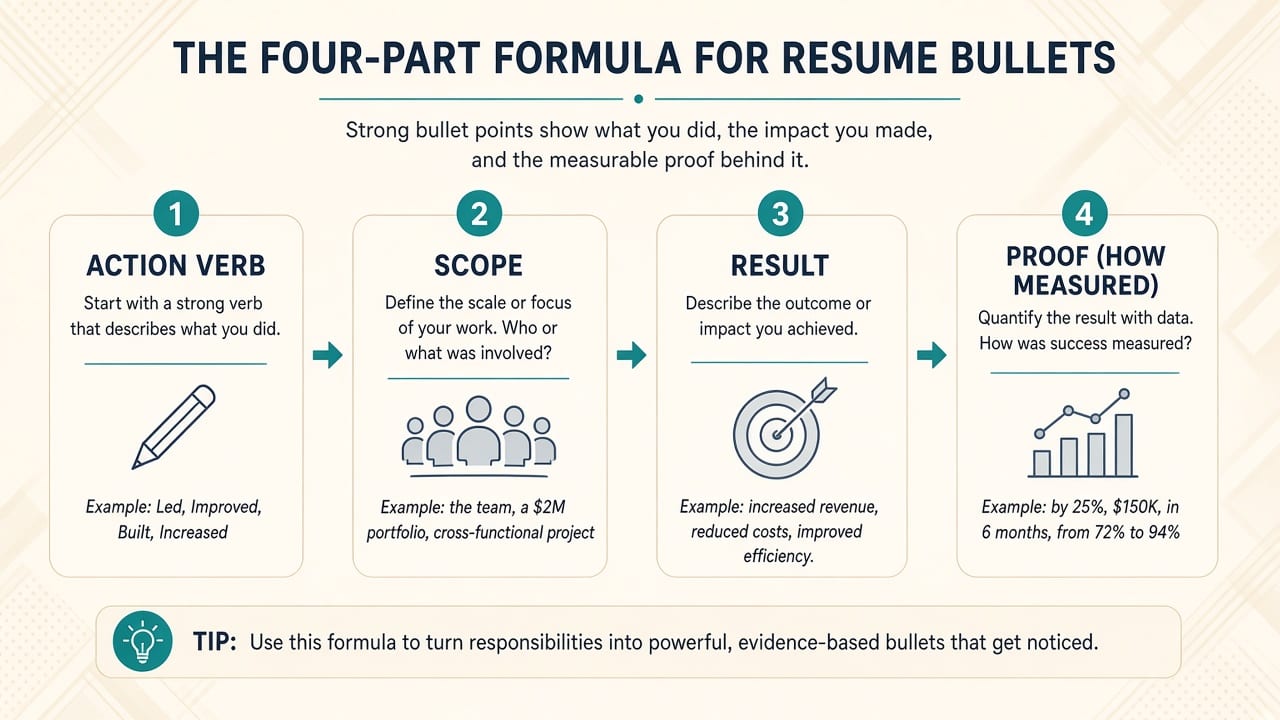
- Use four parts: action verb + scope + result + how you know (even if the "how" stays in your head for the interview).
- Prefer numbers you can explain over impressive numbers you cannot.
- Tailor which bullets you keep, not which tools you pretend you used (keyword stuffing).
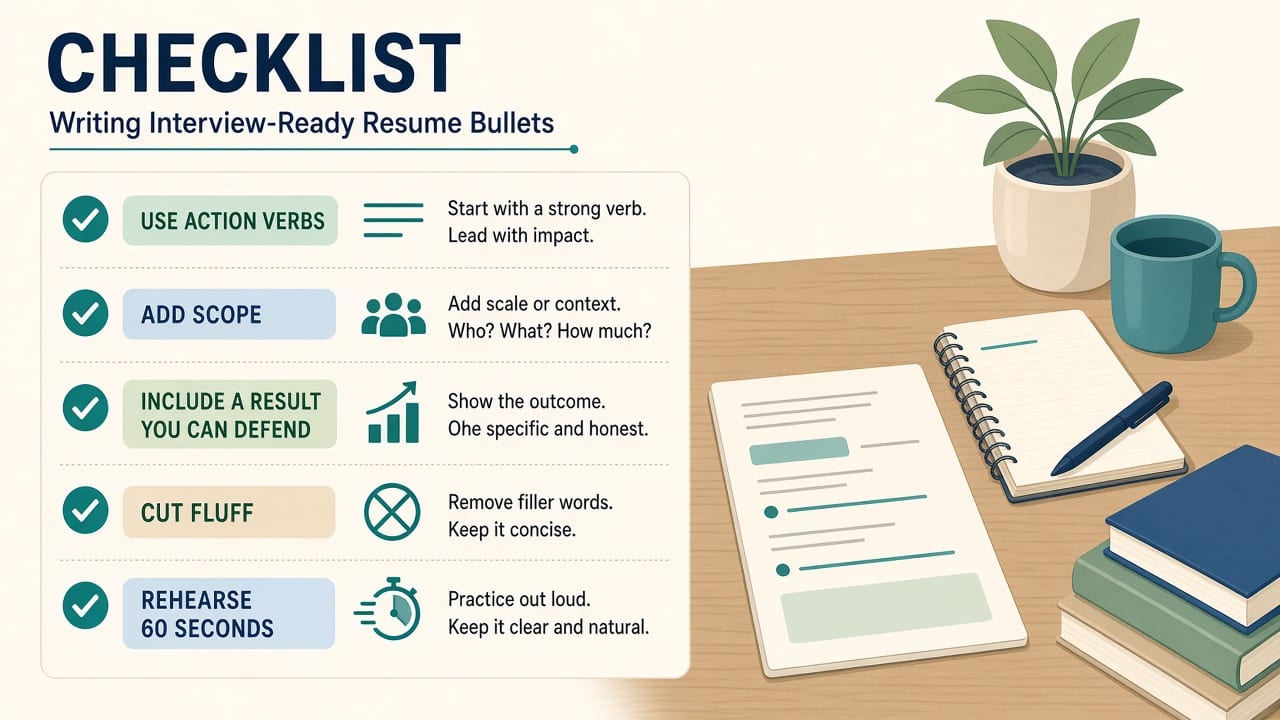
- Run the 60-second explain test on every line you send (interview defense).
The four-part bullet formula
1. Action
Strong verb for what you did: shipped, reduced, redesigned, negotiated, automated. Avoid "responsible for" and "helped with" when you can name the action.
2. Scope
Team size, product surface, customer segment, stack, or cadence. Enough context that the line is not a slogan.
3. Result
Outcome in business or user terms: time saved, error rate, revenue, adoption, reliability. If you have no clean metric, use a concrete deliverable ("launched X to Y users").
4. Proof (interview-ready)
How you measured it, your part vs the team's, and one follow-up you can answer. You do not need all of that on the CV. You need it in your mouth.
Keep most bullets to one line (two max). If it needs a paragraph, cut or split.
Before / after (honest only)
Before:
Responsible for improving customer experience and driving excellence across cross-functional teams.
After:
Reduced average support first-response time from 14h to 6h by rebuilding triage rules with two ops partners.
Before:
Led end-to-end AI transformation using Kubernetes, Python, and leadership.
After:
Shipped a Python batch job that scored churn risk nightly for 40k accounts; partnered with CS to act on the top 5% each week.
Before:
Increased sales by 200% through innovative strategies.
After:
Grew outbound-sourced pipeline from $0.4M to $0.9M in two quarters by rebuilding the SDR sequence and CRM stages (Salesforce).
If you cannot say how you measured the number, delete or soften it. Prompts tell models not to invent exact numbers; you still own every digit you export.
What to cut every time
- "Passionate about" / "results-driven" stuffed into bullets
- Tools you only read about to chase the JD
- "Owned end-to-end" when you owned a slice
- Team wins written as solo heroics
- Metrics that collapse under "how did you measure that?"
- Duplicate bullets that restate the summary
AI can polish wording fast. Open Trust Diff and reject anything that is not already in your profile. Chat can add facts you explicitly provide when you ask, so treat chat as less locked than generate.
How to rewrite a role in 15 minutes
- Scan the posting: must-haves and repeated themes.
- Pull 6-10 true bullets from that role in your master profile.
- Keep the 4-6 that map to this job; demote or drop the rest for this package.
- Rewrite with action + scope + result. Mirror JD language only where accurate.
- Say each line in 60 seconds. Hedge = cut or rewrite.
- Align the cover letter if you attach one (consistency check).
Where CVWiser fits
CVWiser generates application packages from your master profile. At generate time it can rewrite your summary and refine bullets on existing roles, and reorder skills you already saved. It cannot add employers, titles, dates, education, or new skill names. Prompts tell the model not to invent exact numbers; still review Trust Diff and fact-check before export.
Capture a posting with the Chrome extension, see match before a generation credit, then export a parseable PDF/DOCX. Free plan: 3 application packages a month, no card. Start a fresh package or install the extension. Broader thesis: what CVWiser is really fighting.
Frequently Asked Questions
How do you write strong resume bullets?
Start with an action verb, add scope, end with a result you can defend. Rehearse each line in about 60 seconds before you apply.
Should every resume bullet have a number?
Numbers help when they are real. A concrete deliverable beats a fake percentage. Never invent metrics to look quantified.
What is the STAR method on a resume?
Situation and Task become short scope; Action and Result become the visible line. Keep the full story for the interview.
How many bullets per job?
Often 3-6 for recent roles, fewer for older ones. Quality and fit for this posting beat a long dump (one page vs two).
Can AI write my resume bullets?
Yes as a draft locked to your profile, if you review every claim. Reject invented tools, titles, and numbers (fact-check).
The short version
Write bullets you can defend out loud. Action, scope, result, proof. Tailor which true lines you show. Cut fluff and fake quantification. Fact-check, then send.