CVWiser blog
How to Quantify Resume Bullets Without Inventing Numbers
Add real metrics to resume bullets: scale, time, money, frequency, before/after. Use honest ranges when you lack dashboards. Never invent a percentage for ATS.
Everyone says “add numbers.” Few say what to do when you never tracked a clean KPI. Inventing “increased conversion 47%” gets you past a keyword scan and into an interview you cannot finish.
Quantifying a resume bullet means attaching a defensible measure to work you actually did: how many, how often, how big, how much time, or what changed. If you have no dashboard, use scope, frequency, or an honest range. Do not mint precision you cannot explain.
This deepens resume bullets that survive interviews. Pair it with fact-check, Trust Diff, and ChatGPT without lying. Your master profile is where real metrics belong once.
The short answer
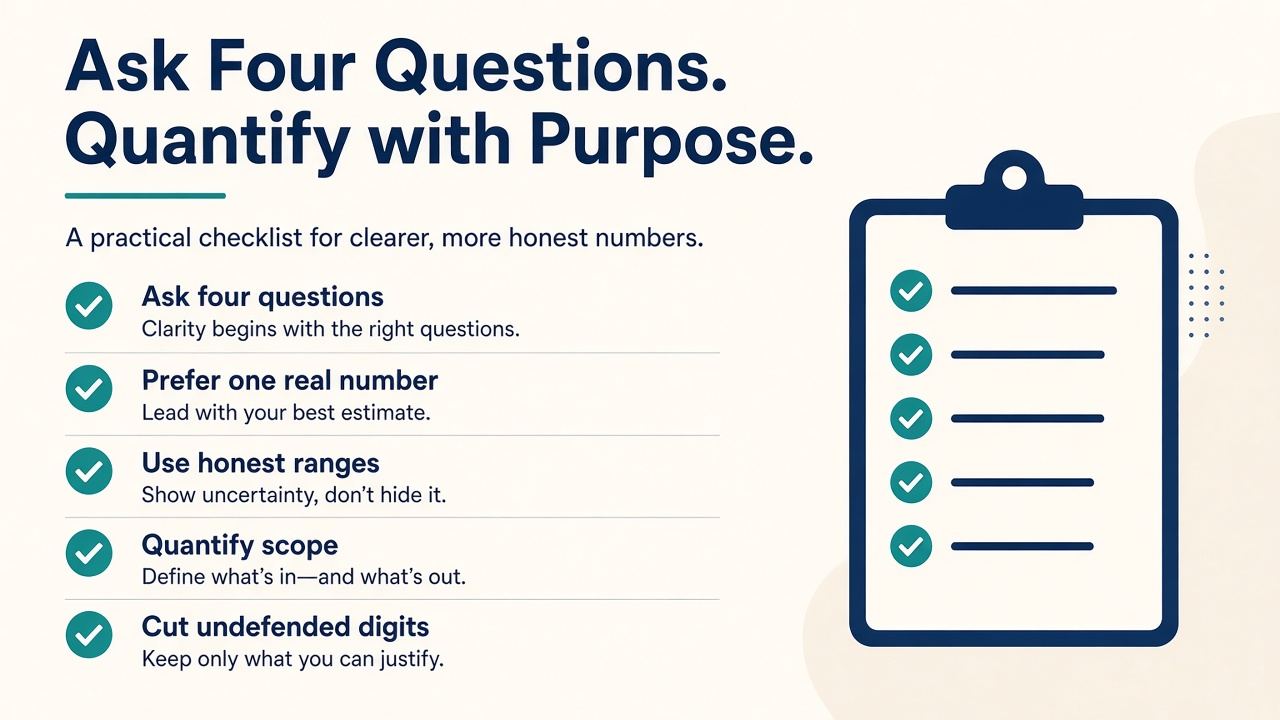
- Ask four questions: how many, by how much, worth what, how fast or how often.
- Prefer one real number over three fake ones.
- Use ~ or ranges when you estimate (“roughly 40–50 tickets/week”).
- Quantify scope when outcome metrics do not exist (team size, accounts, regions).
- Cut any digit you cannot walk through in 60 seconds (interview defense).
You do not need a number on every line. Two or three strong quantified bullets on recent roles beat a wall of invented percentages.
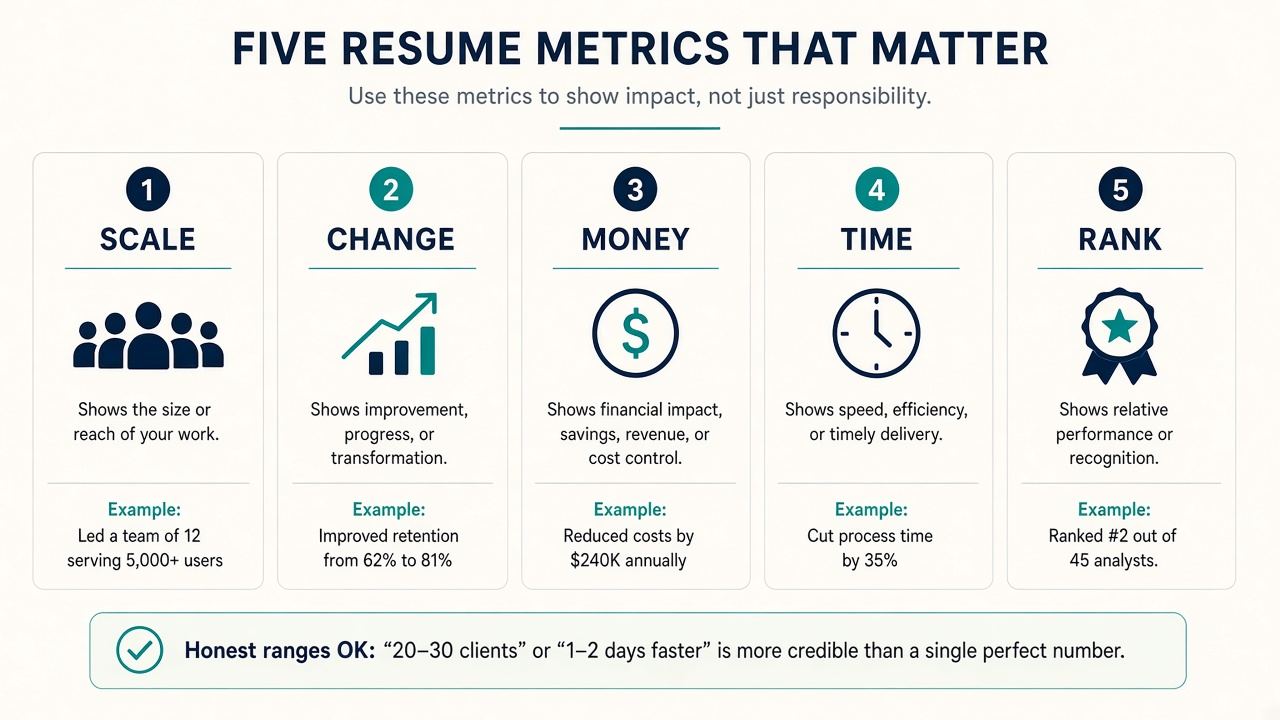
Five ways to quantify (without a dashboard)
| Type | What to count | Example shape |
|---|---|---|
| Scale / volume | People, accounts, tickets, SKUs, users | “Supported ~60 B2B accounts across EMEA” |
| Change | Before → after, % only if you measured it | “Cut close from 11 days to 5” |
| Money | Budget, savings, pipeline you owned | “Owned a $1.2M book of renewals” |
| Time / frequency | Cadence, hours saved, SLA | “Shipped weekly releases for 9 months” |
| Rank / share | Honest team context | “Top 3 of 12 on QA escape rate (team board)” |
If the posting wants “data-driven” language, mirror it only where your proof is real (keyword stuffing vs real match).
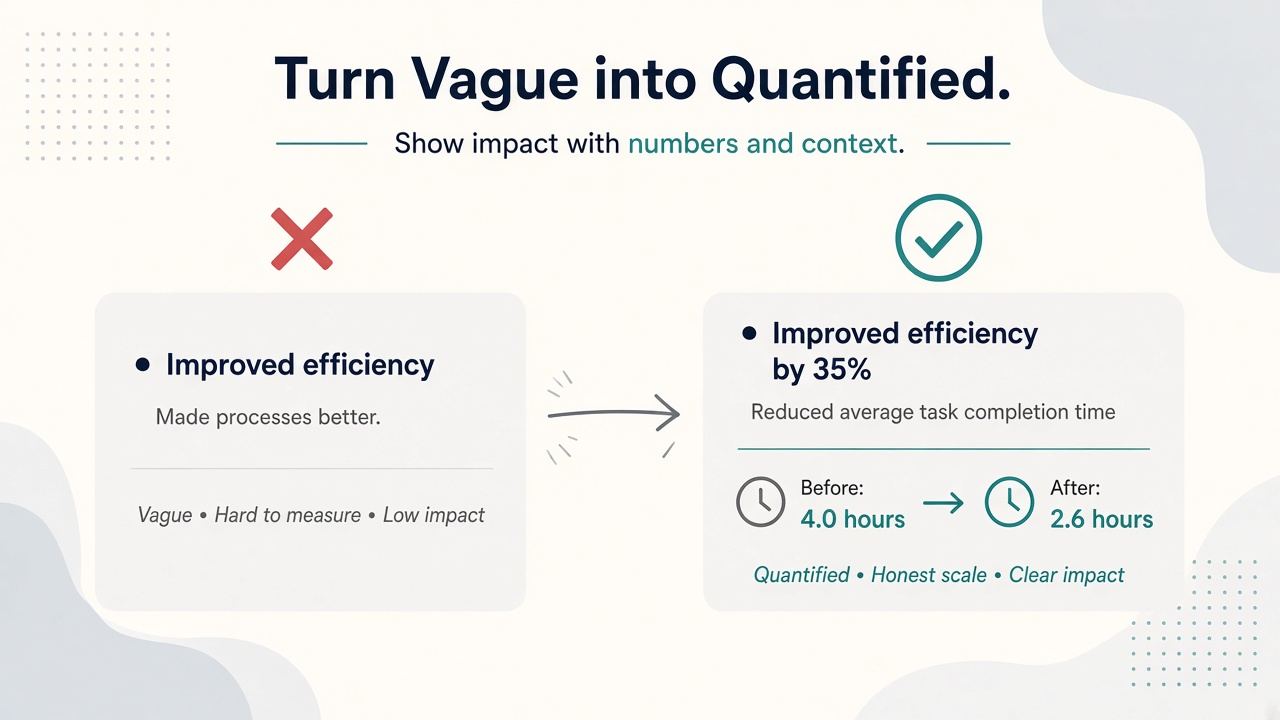
Before / after (honest only)
Before: Improved the onboarding process for new hires.
After: Shortened new-hire onboarding from 3 weeks to 10 days by rebuilding the checklist with HR and IT (12 hires in H1).
Before: Managed social media and grew engagement.
After: Grew LinkedIn posts from ~4 to ~12 per month; average impressions rose from ~800 to ~2,100 (company analytics I pulled monthly).
Before: Increased efficiency by 40% using AI and cross-functional synergies.
After: Automated invoice matching in Excel + Power Query; finance cut manual review from ~6 hours/week to ~2 (estimate from time logs).
Before (no number possible yet): Wrote internal docs for the API.
After (scope, still quantified): Documented 14 public endpoints and 3 auth flows so support could answer without paging eng.
No clean metric? Say the deliverable and the surface area. That is still quantification.
How AI invents metrics (and how to catch it)
ChatGPT and many resume writers love round percentages. They fill silence with “30%,” “50%,” “2x.” Guardrails:
- Ban invention in the prompt: do not add metrics I did not supply; use
[ADD REAL METRIC]instead. - Delete any number you did not provide.
- Prefer tools that lock to a profile and show changes (AI resume builder that doesn’t invent).
- Open Trust Diff. Orphan metrics are a red flag (can recruiters tell).
Ten-minute quantification pass
- Pick your most recent role.
- List 6 true bullets from the master profile.
- For each, answer one of the four questions above.
- Rewrite 2–3 with a number, range, or scope count.
- Say each aloud. Hedge = soften or cut.
- Align the letter if you send one (consistency check).
Where CVWiser fits
CVWiser packages reframe your master profile for a posting. Generate cannot add employers, titles, dates, education, or new skill names. Prompts discourage inventing exact numbers; you still defend free-text metrics and anything you accept in editor chat. Trust Diff makes surprise digits easier to spot before export.
Capture a posting with the Chrome extension, see match before a credit, export, then upload. Free plan: 3 application packages a month, no card. Start a fresh package or install the extension. Thesis: what CVWiser is really fighting.
Frequently Asked Questions
How do I quantify resume bullets if I have no metrics?
Use scale, frequency, or before/after in plain units. “~50 tickets/week” or “from 2 days to 4 hours” beats a vague duty.
Should every resume bullet have a number?
No. Quantify the strongest lines on recent roles. Fake precision is worse than a clear deliverable.
Is it okay to estimate on a resume?
Yes, if you would defend the estimate. Use roughly, about, or a range. Round conservatively.
How do I stop AI from inventing percentages?
Forbid invention in the prompt, require placeholders, and delete any digit you did not supply.
What if my job was not “measurable”?
Almost every role has countable context: people, tickets, pages, shifts, regions, or cadence. Count that.
The short version
Quantify with proof you own. Scale, time, money, frequency, before/after. Estimate honestly. Never invent a percentage for ATS. If you cannot explain the number, do not send it.