CVWiser blog
Resume Summary Without Fluff: How to Write a Profile Recruiters Actually Read
Write a 2-3 sentence resume summary that mirrors the job with real proof. Skip objective fluff and buzzwords. Structure, examples, and a fact-check before you apply.
Your resume summary is the first thing humans skim after your name. Most summaries waste that slot: "results-driven professional seeking a challenging opportunity." That line describes everyone and proves nothing.
A strong summary does one job: in two or three sentences, it states who you are for this role, using language from the posting and facts you can defend. Not your whole career. Not a motivation essay. Not a keyword cloud.
This sits after your master profile and inside tailoring without lying. Fix format and length so the summary is readable, then write it for the job you actually want.
The short answer
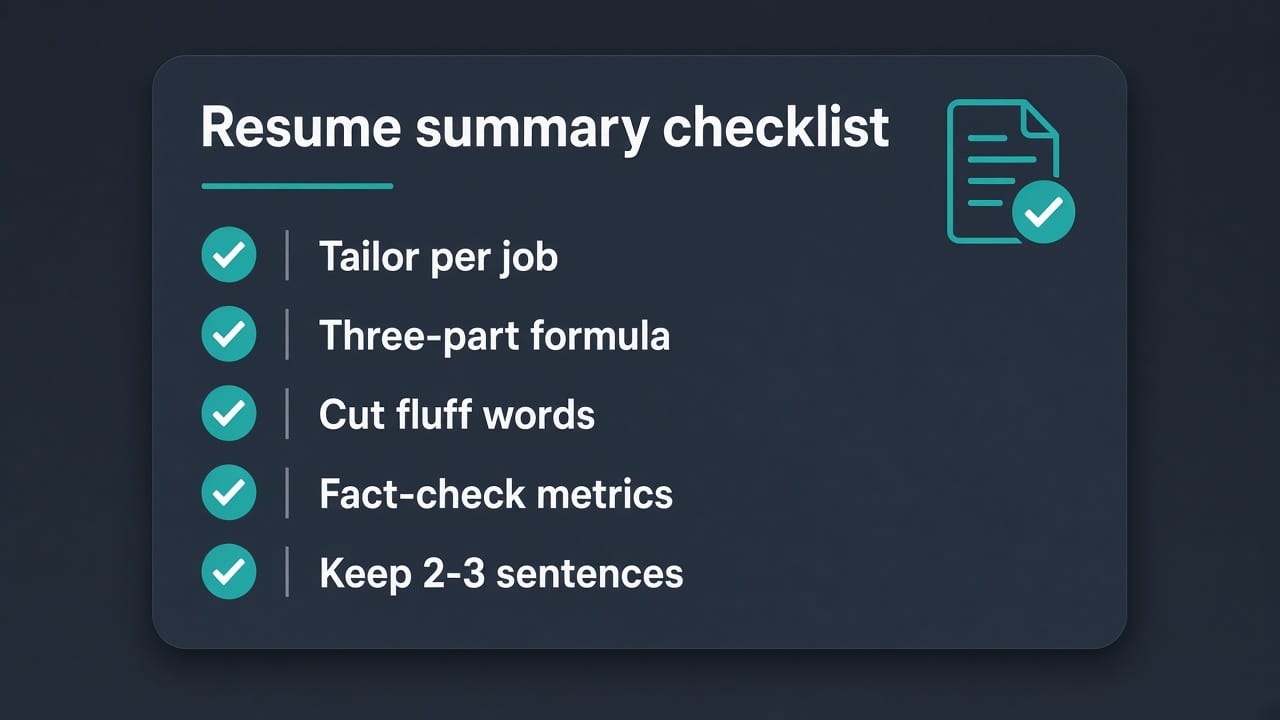
- Rewrite the summary per application from your master profile. Do not reuse one generic blurb forever.
- Use this structure: role / years + strongest relevant domain + one proof point tied to the posting.
- Mirror the employer's language only where it is true (scan the JD first).
- Cut fluff words: passionate, results-driven, dynamic, seeking opportunity, team player.
- Fact-check numbers and titles before export (fact-check, interview defense).
For the full resume objective vs summary decision in 2026 (when a one-line objective still fits), see resume objective vs summary.
Summary vs objective (and why objective usually loses)
| Objective | Summary / profile | |
|---|---|---|
| Focus | What you want | What you offer for this role |
| Typical line | "Seeking a growth role in marketing" | "B2B marketer with 6 years in SaaS demand gen..." |
| Recruiter value | Low | High if specific and true |
In 2026, use a summary (sometimes labeled Profile). Save "what I want" for the cover letter if needed, and keep it consistent (consistency check).
The three-part formula
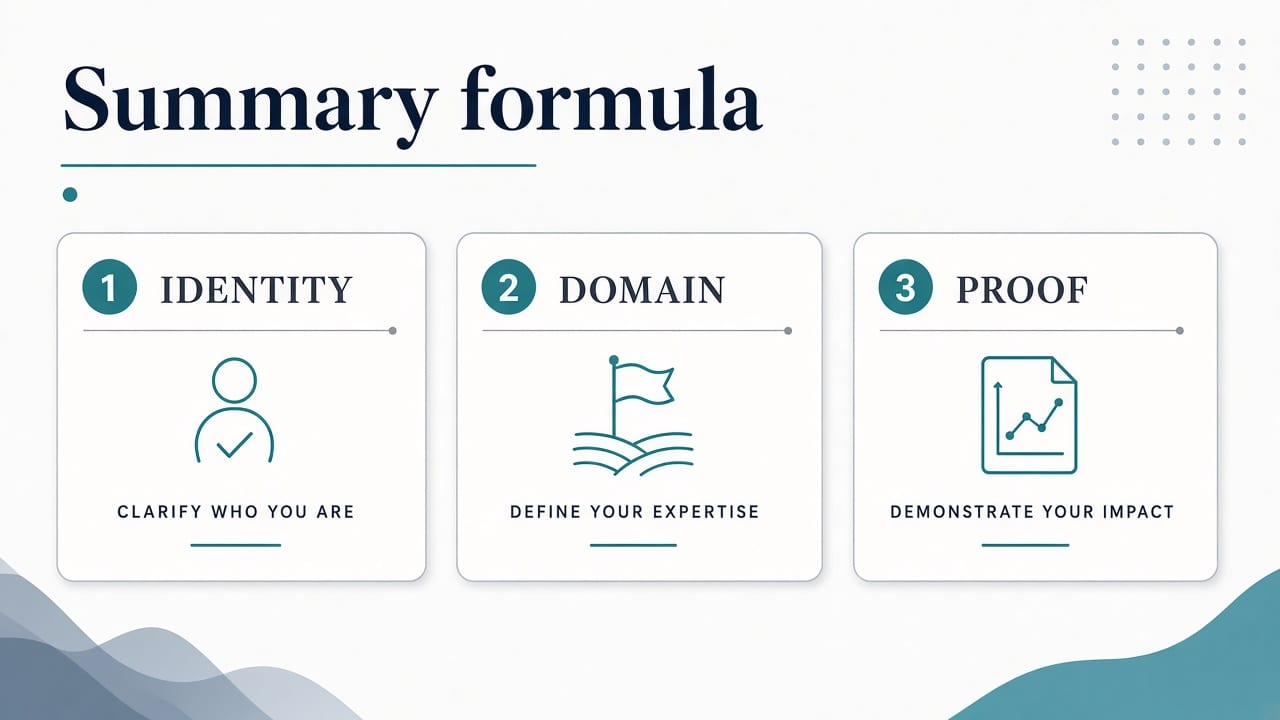
1. Identity for this job
Your current or target-level role and relevant years. Example: "Product analyst with 5 years in fintech."
2. Domain / skill the posting cares about
One or two priorities from the JD you actually have. Example: "Focused on SQL reporting, stakeholder dashboards, and experiment readouts."
3. One proof point
A metric or scope you can explain. Example: "Most recently supported a retention program that cut churn 12% over two quarters."
Keep the whole block to 2-3 sentences. If it needs a fourth, you are writing a cover letter.
Before / after examples (honest only)
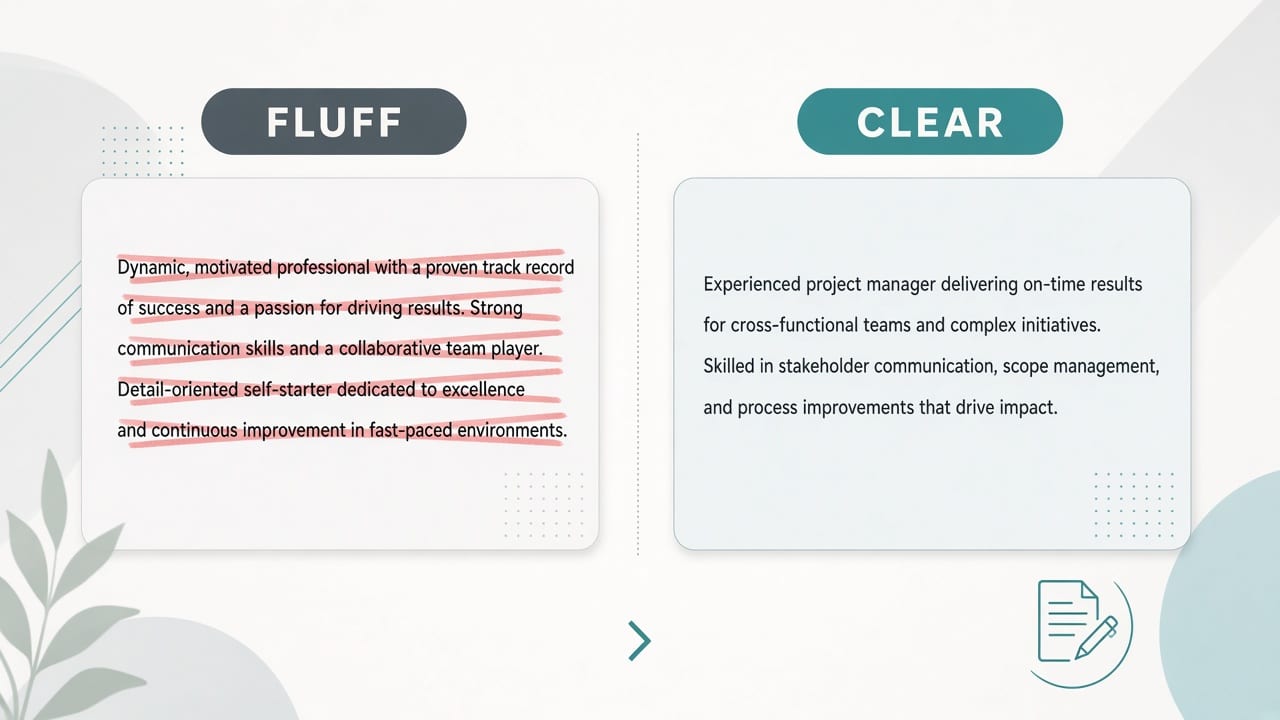
Before (fluff):
Results-driven professional passionate about excellence and seeking a challenging opportunity to leverage synergies in a fast-paced environment.
After (tailored, true):
Operations manager with 8 years in e-commerce logistics. Experienced in carrier negotiations, warehouse KPIs, and cross-team incident response. Led a network redesign that cut average delivery time from 4.2 to 3.1 days.
Before (keyword dump):
Expert in Python, Java, Kubernetes, AWS, leadership, Agile, Scrum, communication, Salesforce, and AI.
After:
Backend engineer with 4 years shipping APIs in Python on AWS. Comfortable with Postgres, CI/CD, and on-call ownership. Built a billing service handling 2M monthly events without inventing tools you never used.
If the posting lists Kubernetes and you have never run it, leave it out of the summary. Stuffing it is how keyword stuffing and recruiter AI-suspicion start.
What to cut every time
- "Passionate about..." / "Results-driven..." / "Dynamic..."
- "Seeking an opportunity to grow..."
- Soft-skill lists with no proof
- Tools you only read about
- Metrics you cannot explain in 60 seconds
- Seniority inflation (Lead / Head / owned end-to-end) beyond your real title
AI can draft a summary fast. It can also invent polish. Open Trust Diff and reject anything that is not already in your profile.
How to write one in five minutes
- Scan the posting: must-haves and top priorities.
- Pull matching facts from your master profile.
- Draft identity + domain + one proof in plain language.
- Swap in the posting's exact terms where accurate.
- Read it out loud. If you hedge, delete or rewrite.
- Keep CV and letter aligned if you attach a letter.
Where CVWiser fits
CVWiser generates application packages from your master profile. At generate time it can rewrite your summary and refine bullets on existing roles, and reorder skills you already saved. It cannot add employers, titles, dates, education, or new skill names. Prompts tell the model not to invent exact numbers; still review Trust Diff and fact-check before export. Chat can add facts you explicitly provide when you ask, so treat chat as less locked than generate.
Capture a posting with the Chrome extension, see match before a generation credit, then export a parseable PDF/DOCX. Free plan: 3 application packages a month, no card. Start a fresh package or install the extension. Broader thesis: what CVWiser is really fighting.
Frequently Asked Questions
How do you write a professional resume summary?
State your role and relevant years, name the domain the job cares about, and add one proof point you can defend. Keep it to two or three sentences and rewrite it per application.
Should I use a resume objective or a summary?
Prefer a summary. Objectives talk about what you want; summaries show what you offer for this role.
How long should a resume summary be?
Usually 2-3 sentences. If it runs longer, move detail into experience bullets.
Can AI write my resume summary?
Yes as a draft, if it stays locked to your real profile and you review every claim. Reject invented metrics, titles, or tools (fact-check).
Do ATS systems read the resume summary?
Many parse the whole document into fields and full text. A clear summary still helps humans first. Format and honesty matter more than stuffing keywords into the top paragraph.
The short version
Ditch the fluff objective. Write a short, job-specific summary from facts you already own. Mirror the posting's language only where true. Fact-check. Then let the rest of the CV prove it with bullets you can defend. For the public profile version of the same honesty rule, see LinkedIn headline and About examples.