CVWiser blog
Resume Objective vs Summary in 2026: Which One Should You Use?
Do you need a resume objective in 2026? Usually no. Use a short professional summary that shows what you offer for this role, with rare cases where an objective still fits.
Templates still open with a resume objective. Recruiters still skip it. If you searched resume objective vs summary in 2026, the default is: drop the “seeking a challenging opportunity” line and write a professional summary that shows what you offer for this job.
This is the decision post. The craft of writing the summary lives in resume summary without fluff. Pair it with tailoring without lying so the top of the page matches the posting without inventing a new career.
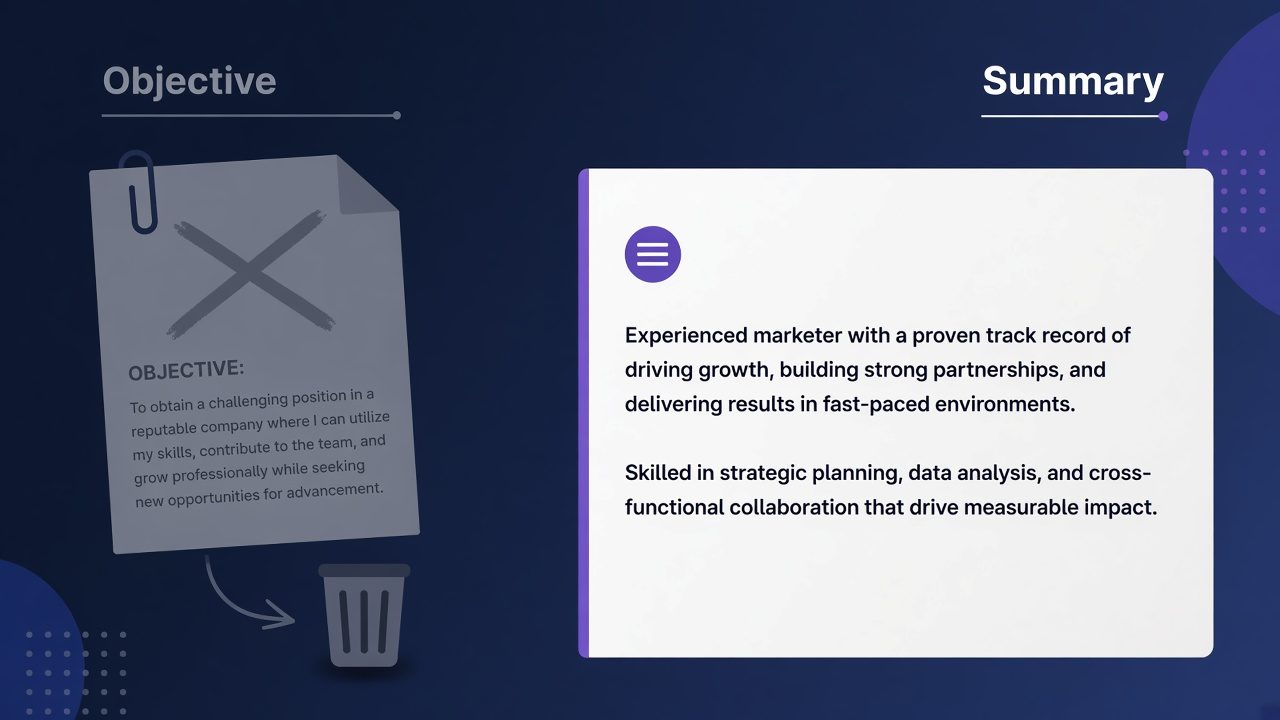
The short answer
- Use a summary for most applications in 2026. Two or three sentences: who you are for this role, plus one proof point you can defend.
- Skip a classic objective on experienced hires. “Seeking a growth role” tells the employer nothing they cannot infer from the fact you applied.
- An objective can still help for a sharp career change, first job, or return-to-work when you need one honest sentence of intent. Keep it short and true.
- Never run both. One top block. Label it Summary or Profile, not Objective plus Summary.
- Rewrite the top block per job from your master profile (master profile). Do not freeze one generic paragraph forever.
Resume objective vs professional summary
| Objective | Summary (profile) | |
|---|---|---|
| Job | What you want | What you offer for this posting |
| Typical line | “Seeking an entry-level marketing role where I can grow” | “B2B marketer with 6 years in SaaS demand gen. Led campaigns that lifted trial-to-paid conversion by 18%.” |
| Recruiter skim | Low | High if specific and true |
| ATS | Extra words, often fluff | Useful if it uses real language from the JD (keywords without stuffing) |
An objective is about you. A summary is about the match. Hiring teams already know you want the job. They need evidence.
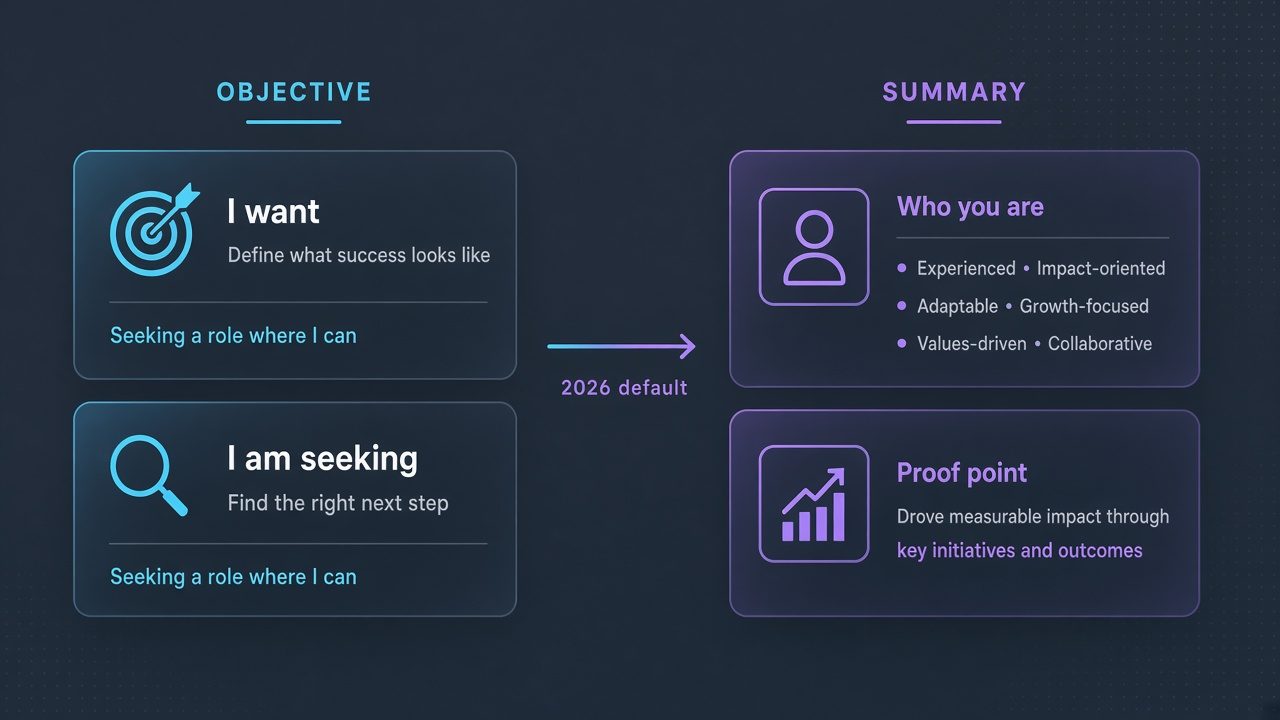
Do I need a resume objective in 2026?
Usually no. If you have relevant experience, lead with a summary. Spend the lines on proof: role, years, domain, one metric or outcome you can explain live (quantify without inventing).
Yes, a one-line objective can still fit when:
- You are changing fields and the title on paper does not scream the target role (career-change resume).
- You are applying to your first professional role and need to name the function (analyst intern, junior nurse, support associate).
- You are returning after a gap and one sentence of intent plus dates in experience is cleaner than hiding the gap (career gap).
Even then, prefer a hybrid: identity + intent in two sentences, not a five-line “passionate professional seeking.” Put longer motivation in the cover letter if you send one, and keep it consistent (consistency check).
What a 2026 summary looks like
Weak objective
Seeking a challenging product design role in a fast-paced environment where I can leverage my passion for users.
Stronger summary
Senior product designer with 8 years in B2B SaaS. Led an onboarding redesign that lifted trial-to-paid conversion by 18%. Focused on self-serve activation and measurable product outcomes.
Rules:
- Mirror the posting only where it is true (scan the JD).
- Cut fluff: passionate, results-driven, dynamic, team player, seeking opportunity.
- Keep numbers you can defend in an interview (interview defense).
- LinkedIn About can expand the same story; titles and dates must still match the PDF (LinkedIn vs resume).
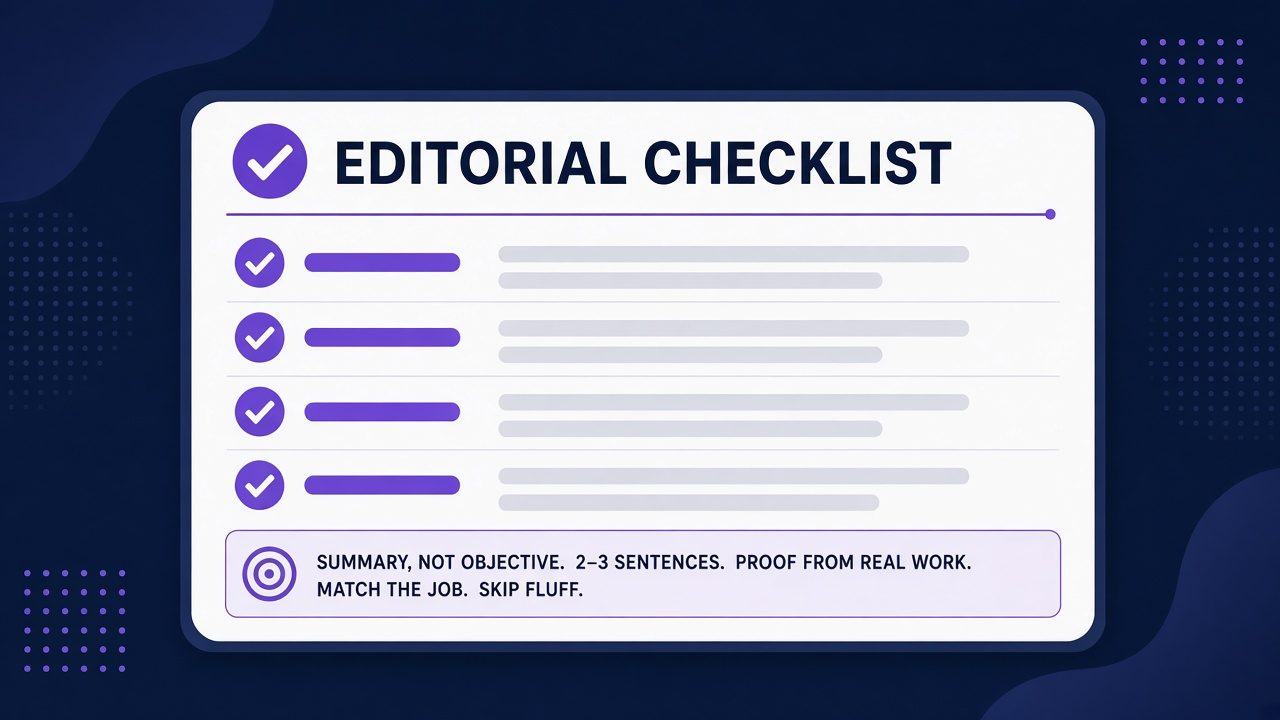
Checklist before you export
- Top block is a summary (or a one-line honest intent for career change / first role)
- No second “Objective” heading
- Two or three sentences, not a paragraph of buzzwords
- At least one proof point from work you actually did
- Language overlaps the JD without stuffing new skills
- Copy-paste test still reads the header as text (ATS format)
Where CVWiser fits
CVWiser stores your master profile once, then rewrites the summary for each application package from facts you saved. Package generate cannot add employers, titles, dates, education, or new skill names. It will not invent a career objective to “complete” a template. Open Trust Diff after generate to see what changed (Trust Diff), then fact-check metrics (fact-check).
Capture the posting with the Chrome extension, tailor, export. Free plan: 3 application packages a month, no card. Start a fresh package or install the extension. Broader thesis: what CVWiser is really fighting.
Frequently Asked Questions
What is the difference between a resume objective and a summary?
An objective states what you want. A professional summary states who you are for this role and what proof you bring. In 2026, summaries win for most experienced candidates.
Do I need a resume objective?
Usually no. Use a short summary. Keep a one-line objective only for career change, first job, or return-to-work when intent is not obvious from titles.
Is a resume objective outdated in 2026?
The long “seeking a challenging role” block is outdated. A two-sentence, job-specific summary is the replacement, not a blank header.
Should I use a professional summary vs an objective on the same resume?
Pick one top section. Two headings waste space and look like a template leftover.
Can AI write my resume objective?
It can draft a summary from your profile. Review every claim. Reject invented metrics, titles, or skills (doesn’t invent).
The short version
In 2026, default to a professional summary. Skip the classic objective unless a career change or first role needs one honest sentence of intent. Keep it short, true, and rewritten per posting. Then let experience bullets do the rest.