CVWiser blog
LinkedIn Headline and About Examples (That Match Your Resume)
Write a searchable LinkedIn headline and About that match your real titles and dates. Examples, formulas, and a sync checklist before recruiters compare you to the PDF.
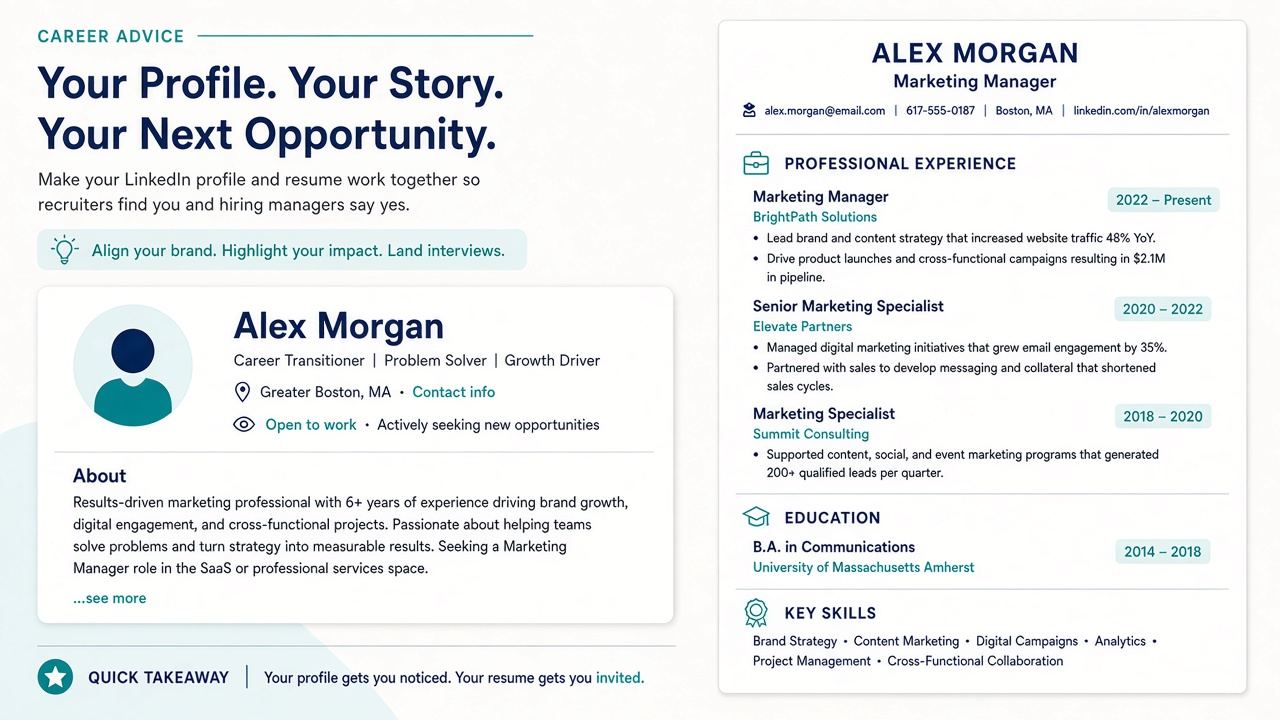
Your LinkedIn headline is not a slogan. It is how recruiters find you in search. Your About section is not a second resume. It is a short, honest story that must still agree with the PDF on employers, titles, and dates.
A strong headline leads with the role you want to be found for, then adds proof terms you can defend. The About expands that story without inventing a promotion your Experience section never had. Keep experience titles and dates locked to the resume (LinkedIn vs resume titles and dates). Put the profile URL on the CV only when it is ready (should I put LinkedIn on my resume?).
The short answer
- Headline = target role + specialty + 1–2 proof terms you actually use.
- Experience titles stay real. Do not “Senior” the resume and leave LinkedIn junior, or the reverse.
- About = who you are, what you do, proof, what you want next. No fluff paragraph of buzzwords.
- Mirror skills you can defend, not a paste of every JD (keyword stuffing).
- Sync before you apply. Same career on LinkedIn and the tailored package (Easy Apply).
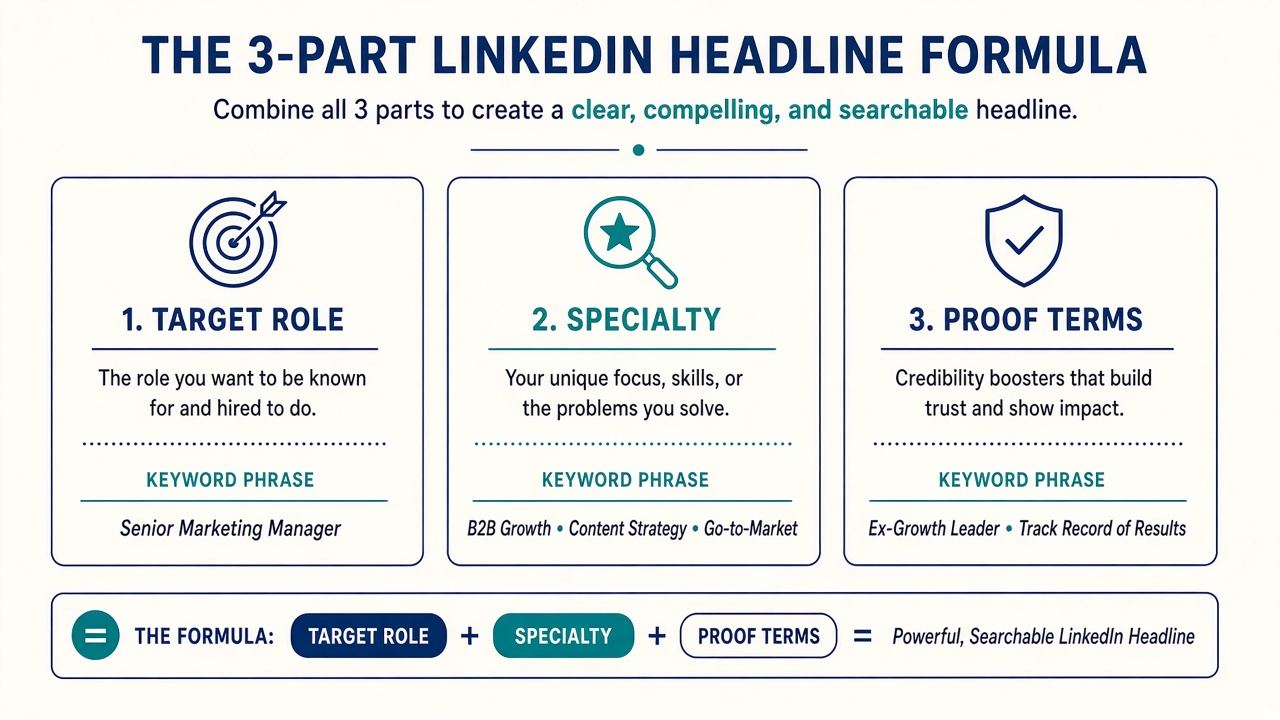
LinkedIn headline formula
Role you want | domain or specialty | proof (tools, scale, or outcome type)
Keep it readable under ~220 characters. Lead with the searchable title, not “Open to work” as the whole line (use LinkedIn’s Open to Work settings for that signal).
Good examples (honest patterns)
Product Manager | B2B SaaS | Roadmaps, discovery, and shipping with engData Analyst | SQL, Tableau, Python | Revenue and funnel reportingCustomer Success Manager | Mid-market SaaS | Renewals and expansionBackend Engineer | Python, AWS | APIs and on-call ownershipMarketing Manager | Demand gen | Paid + lifecycle (HubSpot, GA4)
Weak examples
Experienced professional | Passionate leader | Results-drivenOpen to opportunities(alone, with no role)- A title you never held, copied only to match a posting
The headline can be a search phrase. The Experience section still uses the title you would say in an interview.
LinkedIn About section examples
Aim for roughly 900–1,600 characters. Structure:
- Opening: role + who you help
- Focus: problems you solve
- Evidence: scope, tools, or outcomes from real work (quantify without inventing)
- Direction: what you want next
- Optional: how to reach you
Example (IC product / ops style)
I am a Product Manager focused on B2B workflows. I partner with design and eng to ship clearer admin tools and fewer support tickets. Recent work: discovery on two modules, roadmap tradeoffs with sales, and launches that cut a manual ops step from days to hours. Stack I use day to day: Jira, Figma handoff, Amplitude. I am looking for PM roles where discovery and shipping share the calendar. Happy to connect if that fits your team.
Example (analyst)
Data Analyst supporting growth and finance partners. I build SQL models and Tableau dashboards so teams can see funnel and revenue without waiting on ad hoc pulls. Comfortable with Python for one-off analysis. Looking for analyst roles with clear stakeholders and messy data I can clean.
Example (career change, honest)
Customer Support Lead moving toward Customer Success. Same companies and dates as my resume. I lead a small team on escalations and playbooks, and I want CS roles where retention and onboarding matter. Transferable skills I can defend: stakeholder updates, CRM hygiene, and coaching. Full approach: career-change resume without lying.
Skip invented metrics. If a number is not on your claim ledger, leave it out of About too (fact-check).
Headline vs resume title (what must match)
| Can differ | Must match |
|---|---|
| Headline search phrase vs resume job title wording | Employers and date ranges in Experience |
| About length and tone | Titles you would defend in an interview |
| Which projects you feature | Education dates and school names |
A tailored CV can lead with different bullets. LinkedIn Experience should not invent a second career (consistency with letter still applies when you apply).
Checklist before recruiters compare
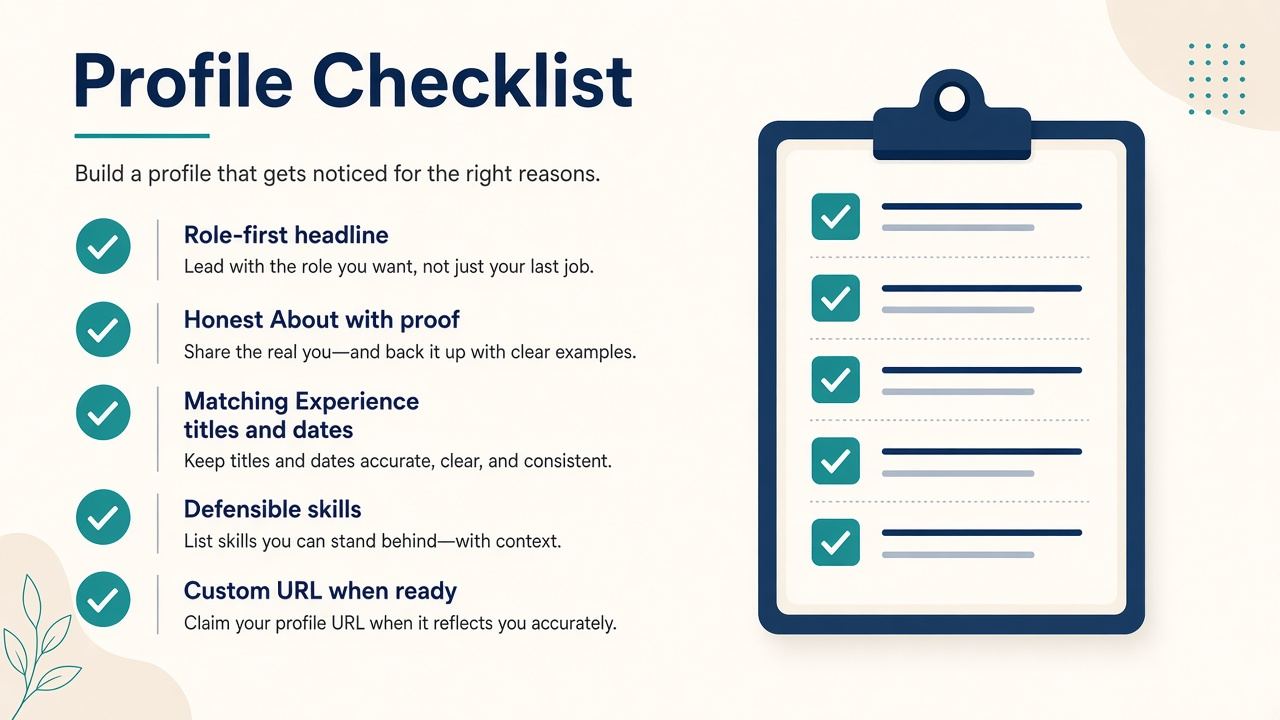
- Headline starts with a real target role.
- About has proof, not only adjectives.
- Experience titles and dates match the PDF.
- Skills list is short and defensible (skills section).
- Custom URL on the resume as text when the profile is ready.
- You can explain every claim in About in 60 seconds (interview defense).
Where CVWiser fits
CVWiser stores one master profile so the resume you export and the LinkedIn you maintain can share the same employers, titles, and dates. Package generate cannot add employers, titles, dates, education, or new skill names. Still review Trust Diff and fact-check. Chat is less locked than generate.
Capture a LinkedIn posting with the Chrome extension, see match before a credit, export, then upload. Free plan: 3 application packages a month, no card. Start a fresh package or install the extension. Broader thesis: what CVWiser is really fighting. For tools that invent careers: AI resume builder that doesn’t invent.
Frequently Asked Questions
What is a good LinkedIn headline for job search?
Lead with the target role, then specialty and proof terms you can defend. Avoid empty buzzwords.
Should my LinkedIn headline match my resume title?
The headline can be a search phrase. Experience titles should match what you would say in an interview and what the PDF shows.
How long should LinkedIn About be?
Short enough to scan. Often a few short paragraphs beat the full character limit.
Can I use ChatGPT for LinkedIn About?
Yes as an editor on real facts. Ban inventing titles, tools, and metrics (ChatGPT without lying).
Do I need keywords in the headline?
Use terms recruiters search for that you actually have. Stuffing tools you never used fails the first call.
The short version
Write a searchable headline and a proof-based About. Keep Experience locked to the same career as your resume. If a recruiter can catch a mismatch in ten seconds, fix it before you apply.