CVWiser blog
One-Page vs Two-Page Resume 2026: How Long Should Yours Be?
One page is the default for most applications. Two pages are fine when the evidence needs space, not when you dump everything. Decide length after your master profile and tailor pass.
People argue about resume length like it is a moral rule. Recruiters do not. They skim for fit. An ATS does not count pages first either; it maps fields. The real question is: does every line earn its place for this job?
In 2026, one page is still the default for most early and mid-career applications. Two pages are fine when you have relevant depth that would otherwise get cut. Three pages are almost never the answer for a standard online apply.
This sits next to your master profile, tailor without lying, resume summary without fluff, and ATS format checklist. Length comes after truth and after parse.
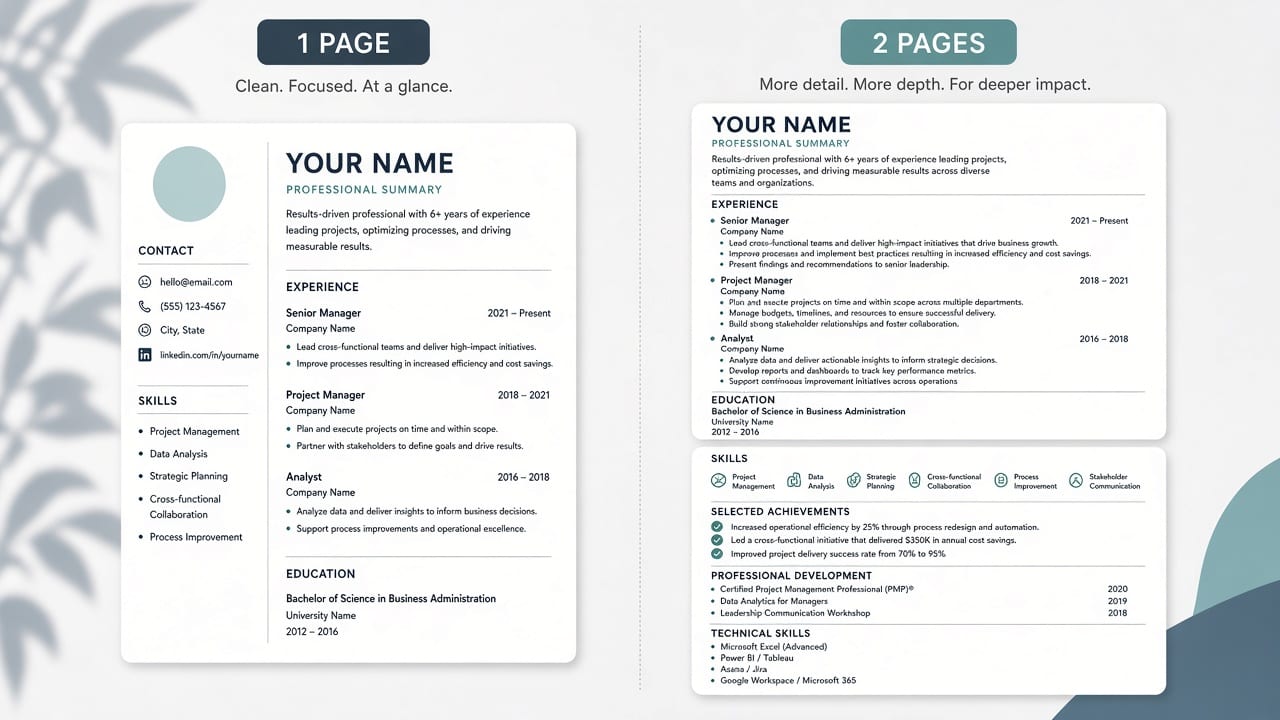
The short answer
- Start from one page for most roles under ~10 years of relevant experience.
- Use two pages when senior scope, publications, or multiple long roles need evidence you can defend.
- Never pad with keyword clouds, soft-skill essays, or old jobs that do not help this posting (keyword stuffing vs real match).
- Tailor length per job. Cut or expand from the master profile; do not invent content to fill space.
- Parse still wins. A pretty two-column one-pager that fails copy-paste loses to a boring single-column two-pager (two-column ATS mistakes).
What recruiters and ATS actually care about
Recruiters skim. The first half page does most of the work: summary, recent titles, proof that matches the posting. Extra pages only help if they add signal.
ATS systems store and search structured fields (employer, title, dates, skills). They do not award bonus points for squeezing everything onto one page with 8pt type. Tiny fonts and crowded columns often hurt parse more than a clean second page.
So: length is a content decision, not a layout stunt.
When one page is the right call
Choose one page when:
- You have under ~8-10 years of relevant experience
- Your strongest proof fits in recent roles
- The posting is standard IC or early management
- You are applying at volume and need fast, clear reads (quality vs quantity)
How to fit honestly:
- Keep bullets on achievements you can explain (interview defense)
- Drop or shrink older roles that do not map to this JD
- Prefer one strong metric over three vague adjectives
- Move skills to a short list, not a sidebar that breaks ATS
If you must shrink by shrinking fonts or margins into unreadability, you are solving the wrong problem. Cut content from the master profile for this package instead.
When two pages are fine (and better)
Choose two pages when:
- Senior / staff / principal / director scope needs more than one page of real evidence
- Academia, research, or federal-style applications expect detail (still stay disciplined)
- You have multiple relevant roles with distinct proof, not filler
- Cutting would remove must-have evidence for this posting
Rules for page two:
- Page one still carries the case: summary, recent roles, top skills
- Page two continues experience or adds education/projects that matter
- Do not save the best bullets for page two
- Same format rules: single column, selectable text, dates with jobs (format checklist, PDF vs DOCX)
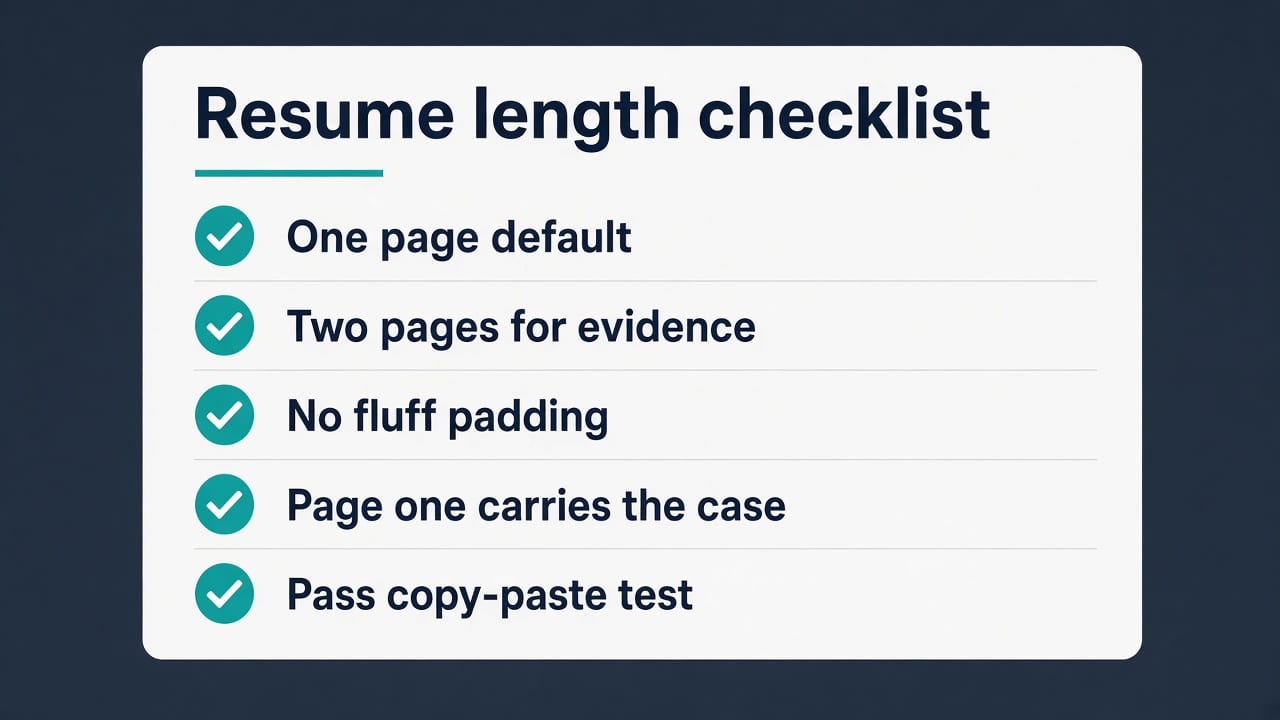
A simple decision test (two minutes)
Ask:
- If a recruiter only reads page one, do they still see fit?
- Does every bullet on page two map to a must-have or priority in the JD (scan the posting)?
- Can I defend every line in an interview?
- Does the file pass the copy-paste test?
If page two fails questions 2-3, cut it. If page one fails question 1 because you crammed, expand carefully or reorder, do not invent.
Common mistakes
Shrinking a two-page story into an unreadable one-pager. Tiny type and narrow margins look "compliant" and parse badly.
Stretching thin experience to two pages. Empty space or fluff reads as junior padding.
Same two-page PDF for every job. Length should change with tailor focus, not stay frozen.
Canva / two-column "one pagers". Page count does not fix parse failure (Canva and ATS).
Stuffing keywords to "use the space". That raises scanner scores and interview risk.
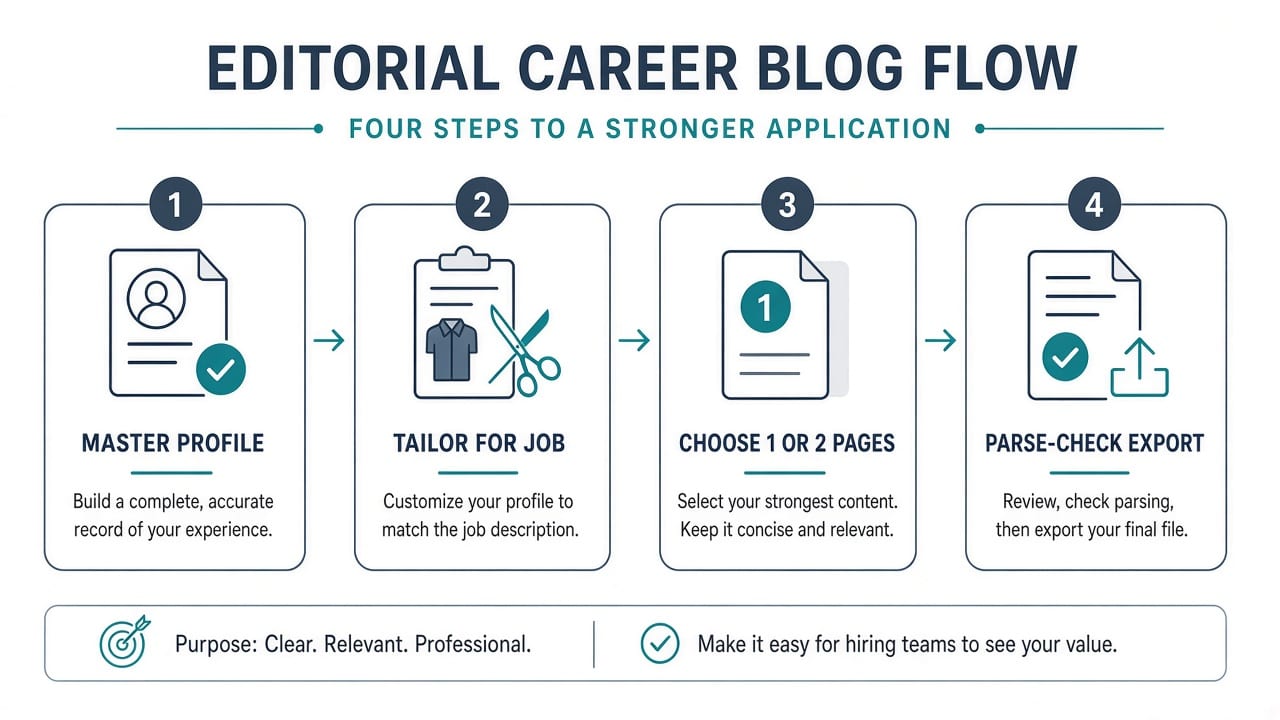
Where CVWiser fits
CVWiser works from a master profile. Each application package can emphasize different roles and bullets for the posting. Package generate cannot add employers, titles, dates, education, or new skill names. You still decide what to keep for a one-page vs two-page export, then review with Trust Diff and fact-check.
Match from the Chrome extension is directional for skills fit. It does not tell you "this must be one page." Eligibility warnings stay separate when profile fields are filled.
Free plan: 3 application packages a month, no card. Start a fresh package or install the extension. Broader thesis: what CVWiser is really fighting.
Frequently Asked Questions
Is a one-page resume better than two pages?
For most applications, yes as a default. One page forces focus. Two pages win only when the extra space holds evidence you can defend for that role.
Is a two-page resume okay in 2026?
Yes, especially for senior or evidence-heavy careers. Keep page one strong, keep format parseable, and cut fluff.
Do ATS systems prefer one-page resumes?
ATS systems prefer readable structure, not a magic page count. A clean two-page file beats a cramped one-page graphic every time.
How long should a resume be for mid-level jobs?
Usually one page. Move to two if cutting relevant recent proof would hurt the match more than the extra skim cost.
Should executives always use two pages?
Not always. Many executives still win with a tight one or two pages of high-signal proof. Title alone does not require page two.
The short version
Default to one page. Use two when the job needs more honest evidence, not more words. Build from a master profile, tailor hard, keep layout parseable, then export. Length is a focus tool, not a flex.