CVWiser blog
Does an ATS Resume Need a Photo? (US, UK, CA, AU)
No for most US, UK, Canada, and Australia ATS uploads. Photos can break parse. When a photo CV is expected, and what to do instead of a headshot on the file.
Does an ATS resume need a photo? For most US, UK, Canada, and Australia uploads, no. Someone may tell you a headshot makes the file “pop.” In those markets it burns space, risks a bad ATS parse, and can invite bias that a plain-text CV is meant to avoid.
This sits next to the ATS format checklist, how to name your resume file, and Canva resume ATS traps. Put your face on LinkedIn. Keep the application file text-first unless the country or employer clearly expects a photo CV.
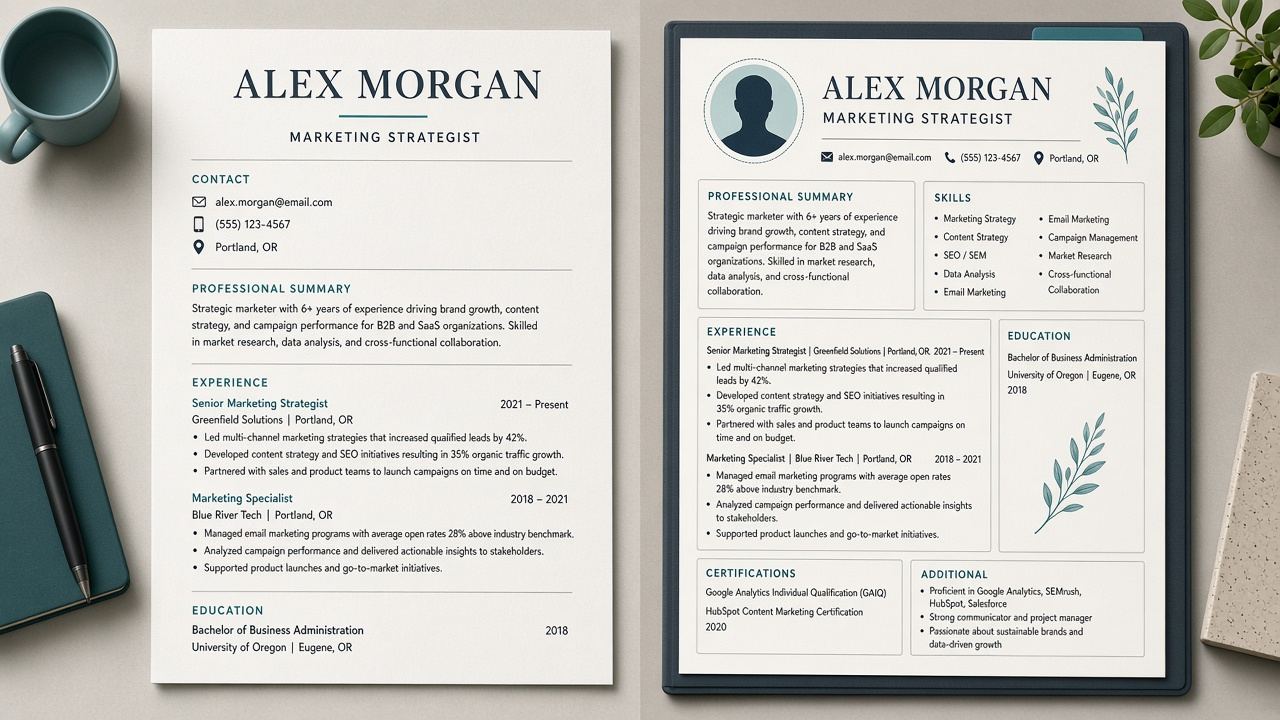
Does an ATS resume need a photo?
No for a typical ATS-friendly resume in the US, UK, Canada, or Australia. The system needs selectable text (name, jobs, dates, skills), not a portrait. Add a photo only when the country or the posting clearly expects a photo CV.
The short answer
- US, UK, Canada, Australia, Ireland, New Zealand: default is no photo on the resume or CV you upload to an ATS.
- Some EU and other markets still expect a photo CV for certain roles. Follow local norms and the posting, not a US template blog.
- Photos break parse when they sit in sidebars, headers, or image-heavy templates (two-column mistakes).
- Use LinkedIn for the headshot. Put a plain-text LinkedIn URL on the resume if you include a profile link.
- Never invent a photo requirement to chase a “premium” look. Honesty and readable text beat decoration.
Why most ATS applications skip the photo
Applicant tracking systems want name, contact, employers, titles, dates, education, skills as searchable text. A headshot is not a field. Embedded images often live in headers, side columns, or Canva-style layouts that fail the copy-paste test.
Common failure modes:
- The photo column pulls skills or contact into the wrong order when pasted into plain text.
- The file becomes heavier and, in bad exports, closer to an image scan than selectable text (PDF vs DOCX).
- Space that should hold one more defended bullet goes to a portrait instead.
Recruiters in no-photo markets also treat an unsolicited headshot as a signal you copied a EU-style template without checking local rules. That is not an automatic reject, but it is not helping.
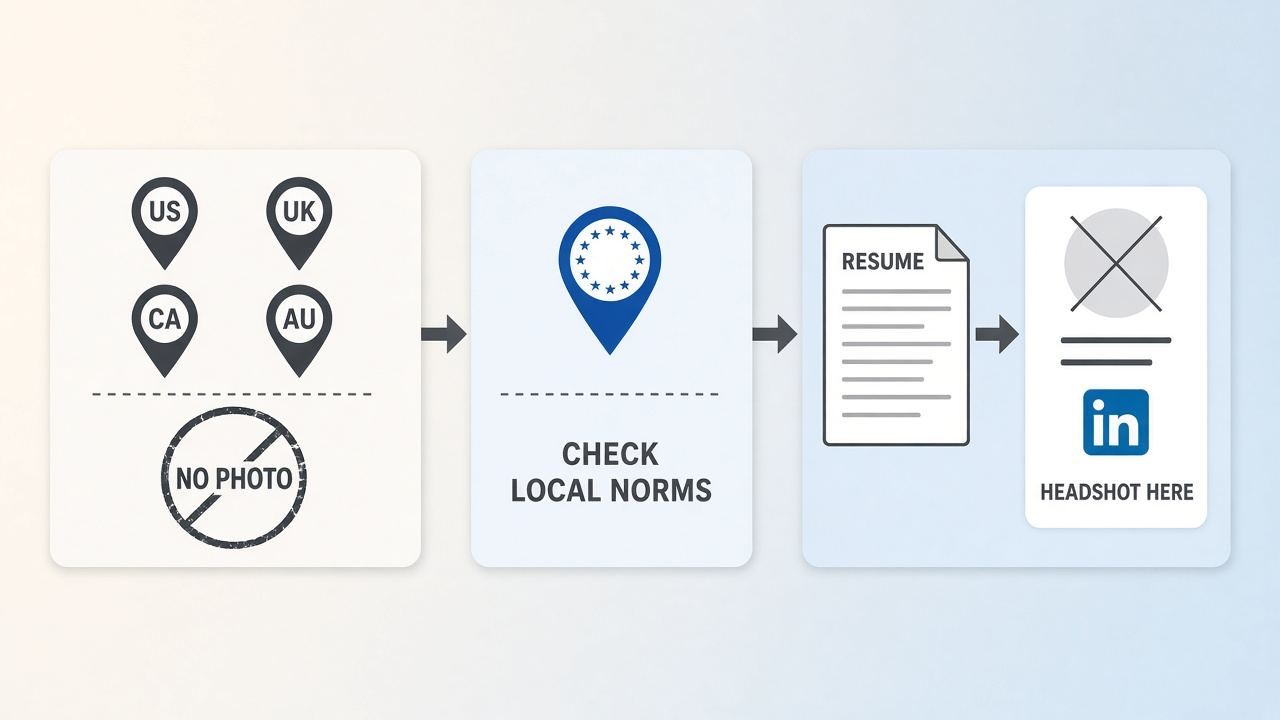
Country and market defaults (practical, not legal advice)
| Market | Typical resume / CV photo |
|---|---|
| United States | No. Photo can raise bias and discrimination concerns. |
| United Kingdom, Ireland | No for most private-sector applications. |
| Canada, Australia, New Zealand | No for most applications. |
| Germany, Austria, parts of Central Europe | Photo CVs are still common in many industries. Follow local guidance. |
| France, Belgium, some other EU roles | Mixed. Check the posting and sector norms. |
| Many roles in Asia and Middle East | Often expected. Confirm for that country and employer. |
Remote roles posted by a US company usually follow the no photo habit even if you live elsewhere. When the employer is clearly local and the culture uses photo CVs, match that culture. When unsure, prefer text-only and put the headshot on your professional profile.
This is not legal advice. Anti-discrimination rules differ by jurisdiction. When in doubt for a regulated market, use a no-photo file for online ATS uploads and ask a local career advisor if photo CVs are still standard offline.
What to do instead of a resume headshot
LinkedIn (or equivalent) carries the face. Keep titles and dates aligned with the PDF (LinkedIn vs resume). A clean custom URL on the resume is enough.
Keep contact as plain text. Name, email, phone, city/region. No icon-only rows that hide the address string (Canva ATS).
Spend the square centimeters on proof. One quantified bullet you can defend beats a portrait (quantify without inventing).
If a posting asks for a photo, send it the way they ask (separate upload, portal field, or photo CV), not as a surprise embed that wrecks parse.
Checklist before you export
- Target market is no-photo → remove headshot, sidebar portrait, and header image
- Target market expects photo CV → use a local template, still keep text selectable
- Copy-paste into Notepad still shows contact and jobs in order
- LinkedIn URL is text if included; face lives on the profile
- No AI tool “upgraded” your layout with a stock face you did not approve

Where CVWiser fits
CVWiser exports text-first PDF and DOCX packages built for parse, not portrait layouts. Professional and Minimalist templates are single-column and do not require a headshot. Package generate cannot add employers, titles, dates, education, or new skill names. It also will not invent a photo requirement. Review Trust Diff and free-text metrics before you send.
Capture the role with the Chrome extension, check match, export a clean file, then put your face on LinkedIn where recruiters expect it. Free plan: 3 application packages a month, no card. Start a fresh package or install the extension. Broader thesis: what CVWiser is really fighting.
Frequently Asked Questions
Should I put a photo on my resume?
For US, UK, Canada, and Australia applications, usually no. Use LinkedIn for the headshot. Add a photo CV only when the local market or the employer clearly expects one.
Does a resume need a photo for ATS?
No. ATS systems need readable text fields. Photos often live in layouts that scramble parse. Run the copy-paste test before every upload.
Does an ATS-friendly resume need a photo?
No. An ATS-friendly file is linear, selectable text. A headshot is optional decoration in no-photo markets and a parse risk in two-column templates.
Can I add a photo to an ATS-friendly resume?
You can, but you usually should not for US, UK, CA, or AU ATS uploads. If a local market or the employer requires a photo CV, keep the text selectable and follow how they ask you to send it.
Is a headshot on a CV okay in Europe?
In some countries and sectors, yes. In others, norms are shifting. Follow the posting and local practice, not a single global rule.
Can a photo hurt my application?
In no-photo markets it can look out of place, waste space, and break ATS layout. It can also introduce appearance bias that a text resume is meant to reduce.
Where should recruiters see my face?
On your LinkedIn (or local equivalent) profile, with a LinkedIn URL on the resume if you include one.
The short version
Skip the resume photo for most English-speaking ATS applications. Keep the file single-column and selectable. Put the headshot on LinkedIn. Name the download FirstName_LastName_Resume.pdf (resume file name). Use a photo CV only when the country or posting expects it, and never at the cost of a failed copy-paste test.